














Home Blog Page 28

“Getting into this University was a Far-Fetched Dream. I was Even Advised to ‘Stick to my Lane’ –Regina Mugure Mwangi’s Story
6

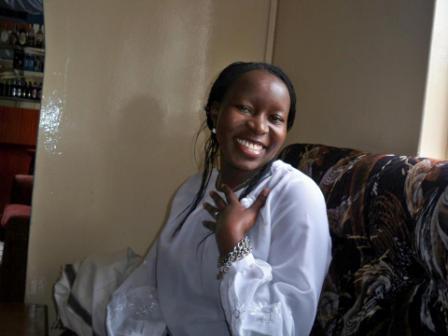
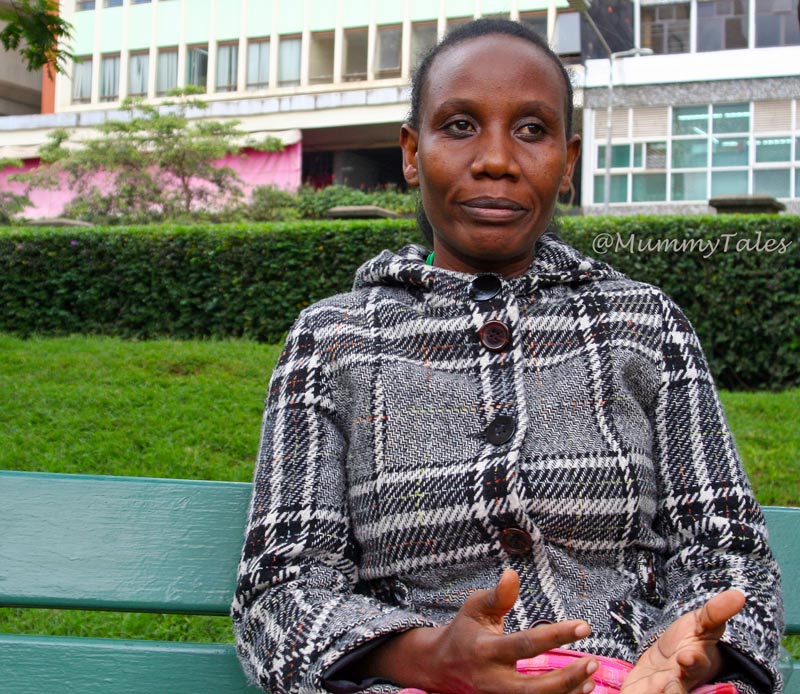
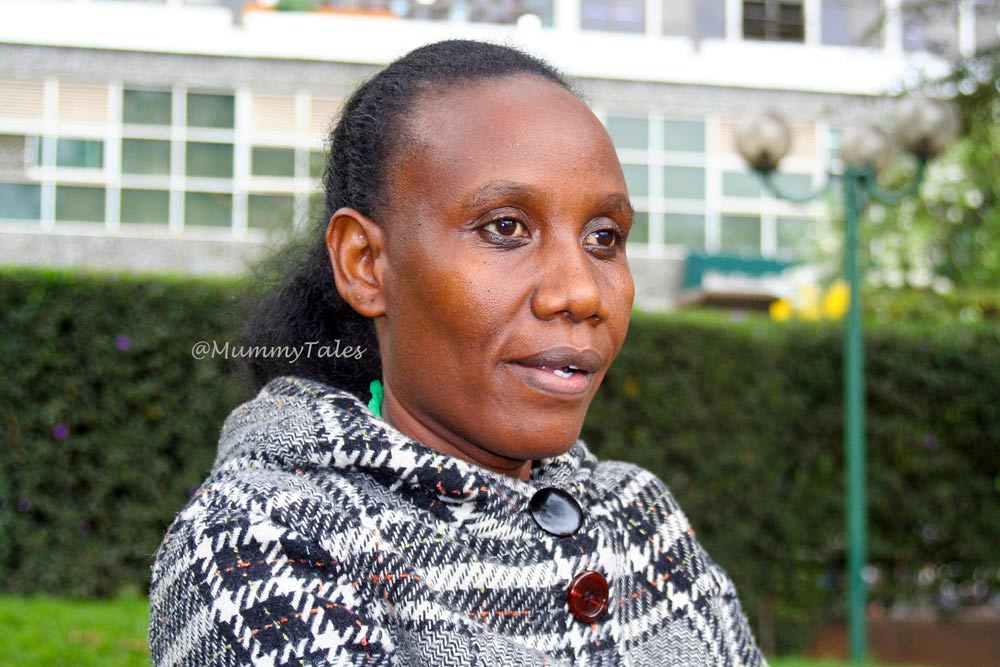
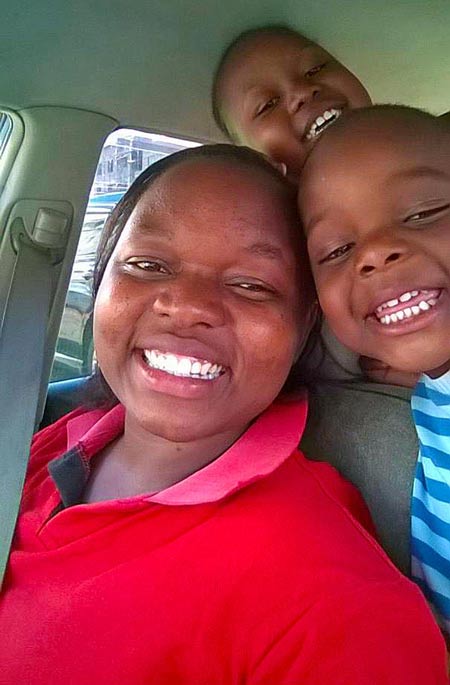
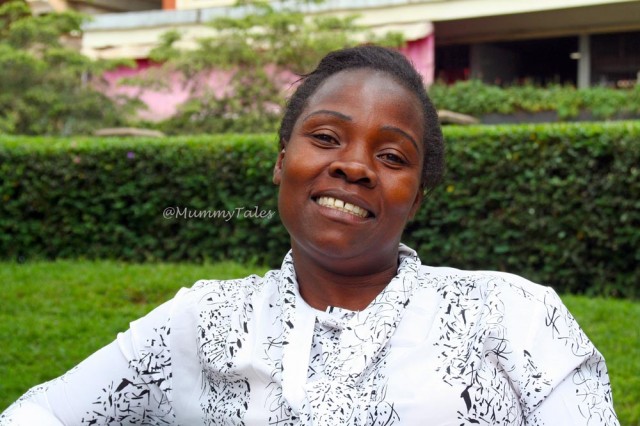
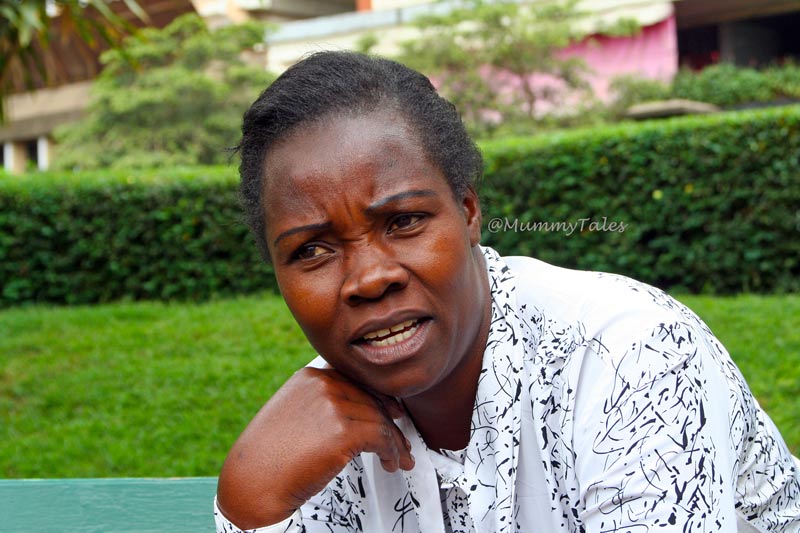
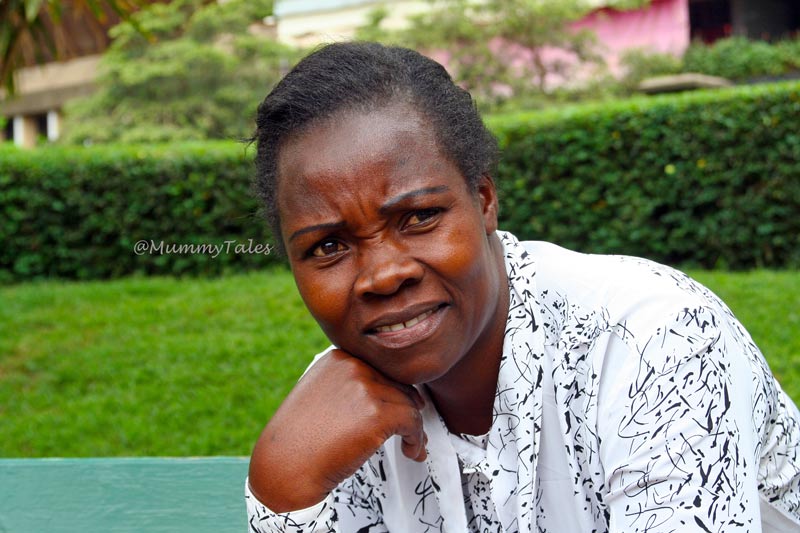
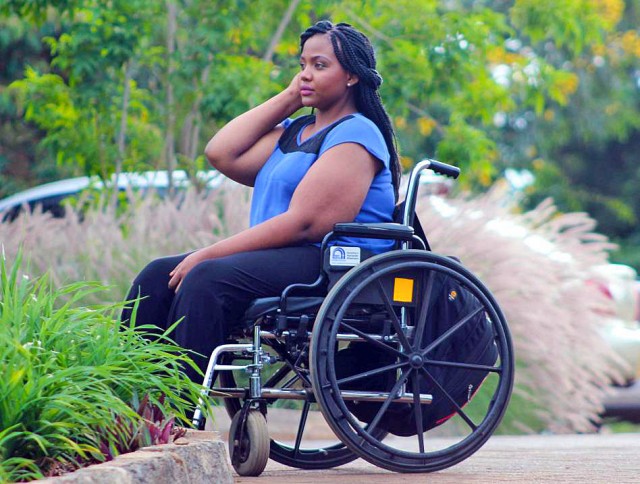
You most likely have seen her on TV. 23-year-old Regina Mugure Mwangi is the face of the #NikoEducatable campaign, which encourages people to support the education of children with disability. I recently met Regina at her campus USIU Africa, where we spent a lovely afternoon chatting. Today, I bring you her story. Read on, and feel free to share the article.

“I was born healthy and I have fond memories of my early childhood in our rural home in Murang’a. In kindergarten, I loved playing and singing with my friends. Life was good! However, something unusual began happening just as I was about to enroll in class one.

My parents tell me that I suddenly began dragging my feet –for reasons they couldn’t understand. They took me to hospital and I was given medication, but the problem persisted. With each passing day, my walking became slower and slower as my feet became heavier and heavier.

My parents brought me to Nairobi for further treatment, but several hospital trips later, there was never a clear diagnosis of my problem. By this time, I had stopped going to school because my knees and legs had become too weak. My siblings and I were at that time staying in Kiambiu slums in Eastlands. Our mother had remained back home in Murang’a to tend to the farm.

Eventually, when I was 10 years old, dad found a school for me and I enrolled in class one. I was way older than my classmates. It was a privately-owned informal school in the slum. My dad had tried getting me into a special school, but the schools were far, and the transport logistics were too costly for him.
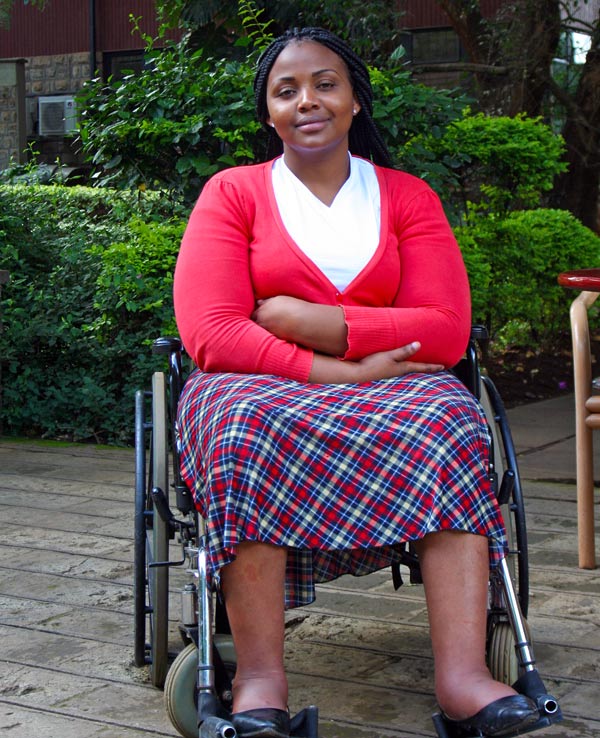
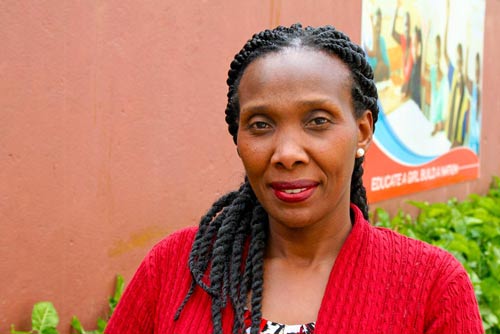
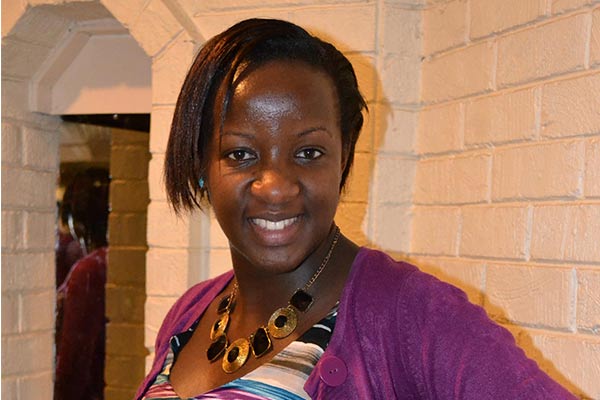
Regina, when I met her last week.

When I was in class 2, my dad got some reprieve when an Italian organization called Centrum Narovinu that sympathized with my plight offered to pay my school fees. However, my health challenges persisted. In class 3, my mobility became almost impossible because by that time, my knees had stiffened completely and I was unable to stretch my legs or even get up. Some neighbors told my dad about an organization called the Association for the Physically Disabled of Kenya (APDK), and urged him to reach out to them. It is this organization that facilitated my access to AIC Kijabe Hospital where I underwent knee surgery.

After the surgery though, the doctors told my parents that there was yet another problem with me –this time even more serious than my knees and legs.

Apparently, my back had a major problem -somewhere around the spine. They recommended more surgery, but informed my parents that it could go two ways: that I could get worse, or I could get better.

My parents, fearful that the surgery would aggravate my condition or even worse –that I would die under the operating table, decided against the risky procedure and took me home. I was given a wheelchair to assist with my mobility, and I continued attending therapy at APDK twice a week.
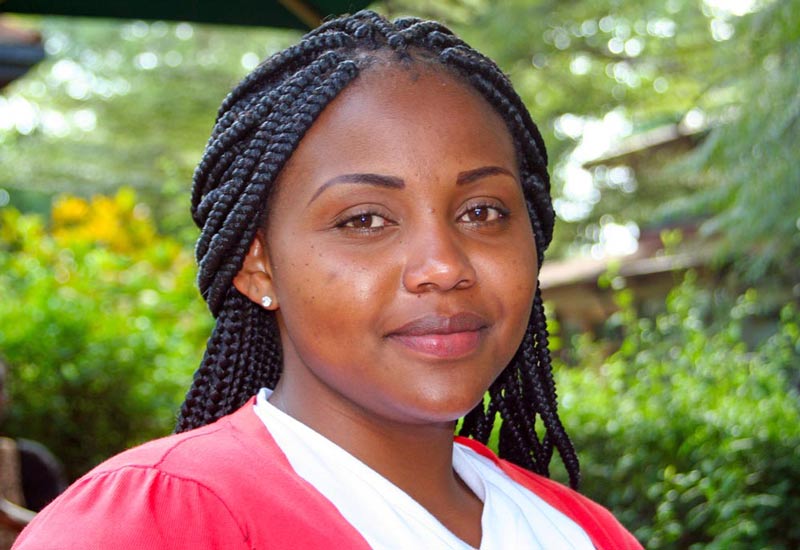
Regina-Mugure-Mwangi-1-b

I continued with my education at the school, grateful to the Italian organization that sponsored my education. However, when I was in class 7, the school suddenly closed down after its owner got into financial difficulties. That left my dad, a jua kali artisan completely helpless as he didn’t know where else he’d find a school for me.

Moving through the difficult slum terrain on a wheel chair was tough, and he couldn’t afford to hire private transport for me. So I stayed at home as I watched the days and weeks turn into months. Month after month, I would look forward to my dad coming home with some good news, but it never happened. I would watch my friends go to school and listen to their stories about school when they returned. I desired the same for myself so much…

Continue Reading Next Page

The List of 6 Cartoons that have been Banned by Ezekiel Mutua Because they Promote Homosexuality

1

Following public outcry about some cartoons some of our kids watch on pay TV, and which seemingly glorify the Lesbian, Gay, Bisexual and Transgender (LGBT) agenda, the Kenya Film Classification Board (KCFB) headed by Chief Executive Officer Dr. Ezekiel Mutua has written to Multichoice and asked them to immediately discontinue the broadcasting, distribution or exhibition of the programmes.

The six named programmes are:

  1. The Loud House (shows on Nickelodeon)
  2. The Legend of Korra (shows on Nickelodeon)
  3. Hey Arnold (shows on Nickelodeon)
  4. Clarence (shows on Cartoon Network)
  5. Steven Universe (shows on Cartoon Network)
  6. Adventure Time (shows on Cartoon Network)

Ezekiel-Mutua-KCFB-sml

Dr. Mutua (pictured) says that the cartoons are laced with subtle messages normalizing, glamorizing or even glorifying homosexual behaviour, which goes against Kenya’s morals and values.

This is interesting news. Do your kids watch the mentioned cartoons? Do they love them? Have you ever noticed the kind of content that Dr. Mutua is referring to? What do you think of KCFB’s move?

See below for the full statement.

KFCB-1

KFCB-2

Ezekiel-Mutua-3bc

Ezekiel-Mutua-2-b

featured images: Nickelodeon l Ezekiel Mutua Twitter

For more topical parenting  issues and stories, follow Mummy Tales on: FACEBOOK INSTAGRAM TWITTER 

House Helps in Kenya: It’s Been Nine Great Years with my House Help, and Here’s Why that has Worked Out

2

Hello moms. One of the most widely-read blog posts here on Mummy Tales is this one: Caroline Kinyanjui: I Have been with my House Girl for 13 Years. Caroline’s story is an interesting read for many reasons, chief  among them being that she’s one of the few moms today who have managed to stay with one house girl that long. So we’re all curious to know exactly how Caroline does it. Be sure to read her story in case you’ve never read it. 

Now, I recently talked to a mom who has been with her house girl for 9 years –which is still a considerable lengthy time in this day and age if you ask me. So I asked her if she’d be kind enough to share a few tips on what she’s learnt, and the advice she can offer us on the same. This is what this mom, a human resource and career expert said:

1.   I have accepted the fact that no one will do things perfectly in the house the way I want them to be done – apart from myself. When I find something hasn’t been done the way I want, I point it out and if I have time I’ll do it myself. When this happens, chances are that next time I’ll find it well done.

2.   As long as the basic chores around the home are done and my children are healthy and happy with the house girl, that is an A+ for me.

3.   You can never find that perfect house girl. It is simply impossible. If you keep firing one after the other because of any mistake they do, you’ll keep firing them forever.

Also Read: Do You Have a High Turn Over of House Girls? Be Careful About That

4.   In the same breath, house girls makes mistakes, sometimes very serious and expensive mistakes, but the way you handle the issue matters. I have dealt with such situations in a sober and mature manner, with an understanding that no one is perfect –including myself. Besides, we all make mistakes at work, in our businesses and unfortunately sometimes with our children. So if an item is not well-cleaned, ironed or even broken, or if the food is not well prepared, communicate with her – and if you cannot cope, just release her.

5.   Don’t yell at your house girl, or anybody else for that matter. When someone shouts at you, it demoralizes you and makes you feel terrible, so don’t do the same to her. Remember you leave your children with your house girl when you’re away at work or running errands, so yell at her at your own peril.

Also See: When Should you Increase Your House Girl’s Salary and by How Much?

6.   Sometimes when I get annoyed at things she’s done I relax, take a deep breath and try to rectify what could have gone wrong

7.   My house girl did not complete school, but is attending “gumbaru” (adult education classes) to at least learn to read, write and speak some English and hopefully establish a business sometime in the near future.

8.   Much as many people may find it hard to accept, a house girl’s work should be respected just like any career. I know of house girls who have educated their children up to university level through their work. As a career expert, I believe that any job that gives you satisfaction, an income and dignity is a career like any other. Nowadays, women are enrolling in colleges to learn how to be professional house girls and domestic managers. I know of one live-in house girl who earns Sh50,000 per month. Through the years, she has been able to give her children a good education. So why wouldn’t she be proud of that and work until she retires?

Well, so those are the experiences of this mom. Just like I have, I hope you’ve picked a thing or two that you can apply in your own situation. So how long have you had your house girl for? What have been your experiences? If you’ve had one for at least more than 5 years, what tips would you share with fellow moms?

You may Also Like to Read:

Tabbz-3

The Day I Found out my House Girl was HIV Positive

Edith-Murogo_Centre_for_Domestic_Workers_and_Training-2

12 Questions to Ask when Interviewing a House Girl

Milka_Kihara

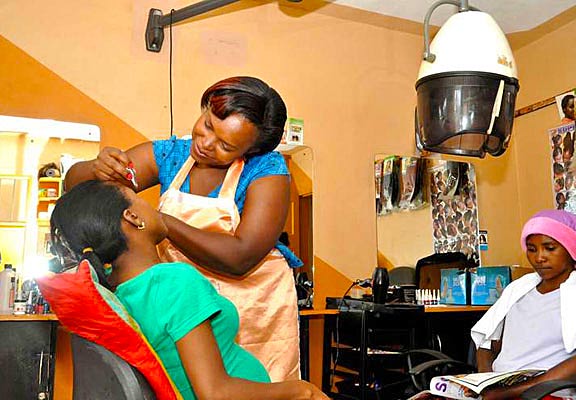
Former House Girl Starts her own Salon Business

The topic of house girls is one that most moms can go on and on and on about. So what’s your experience?

Mummy Tales is a blog dedicated to empowering its readers on different aspects of maternal and newborn health, as well as various issues surrounding motherhood and women. Read more motherhood experiences of Kenyan moms hereFollow Mummy Tales on: INSTAGRAM TWITTER 

We Were told that ‘Boys have Delayed Milestones’ so we Needn’t Worry. But they were Wrong. Our Son had a Problem

1
They boy, Safari.

Wairimu is aunt to seven-year old Safari. She dots on the young lad, who has a special place in her heart. Wairimu and Safari’s mom are twin sisters, and the closeness between the sisters has made Wairimu assume many of the responsibilities of raising Safari, who has special needs. Today, Wairimu shares with us the experiences of raising Safari, including the pursuit of an education for him. I welcome you to read her story*.  

“When Safari was just three months old, we knew that something was wrong with him somewhere, though we couldn’t tell exactly what it was. His head was still very wobbly and when we placed him on the sofa, he would easily topple over so we had to put a pillow on both sides to prevent him from doing so. Worried, we asked some doctors about his seemingly slow development. But the answer was always the same: that boys have ‘delayed milestones’, meaning their growth lags behind that of their girl peers.

And so assured, we waited and waited…..and continued waiting….

But as we continued waiting, one particular incident was never far from our minds. This was something that happened when he was a newborn.

At only six days old, he had suffered jaundice. Many babies experience mild jaundice, which is a yellow tint to a newborn’s skin and the white part of the eyes. This is a sign that there is too much bilirubin in the baby’s blood. But it usually gets better or simply goes away on its own within a week or two –without causing any problems. However, in rare cases, if the bilirubin levels remain high and without appropriate medical attention, it could lead to brain damage called kernicterus. That is apparently what our baby had. Neonatal kernicterus. Safari was admitted to Kenyatta National Hospital, where he underwent a blood transfusion and was placed under photo-therapy. I remember his little eyes being so tightly bandaged to ensure that no light reached or affected them. I wondered if it hurt him.

Dr_Ribeiro_Parklands_School

But as I mentioned earlier, he wasn’t developing at the rate of most children his age. Something about him still bothered us. At almost two years old, he still couldn’t stand on his own, while his peers were running. But yet, we kept being told that ‘boys achieve their milestones late, so just relax, there’s nothing wrong with him’. Unsettled, we took him to the hospital and eventually, we were given a diagnosis of Cerebral Palsy, a disorder that impairs control of movement caused by damage to the developing brain.

The news was hard to take in. We believe that the neonatal kernicterus contributed to his cerebral palsy. Interestingly, the conversations we’ve had with other mothers who have children with cerebral palsy are almost similar; they all say that their children fell sick at some point soon after birth. For some, it was jaundice, malaria, others meningitis, others something else. But there was a sickness involved somewhere in those first weeks. Same case with Safari.

After we were told he had cerebral palsy, I admit we struggled to accept that his special needs were going to be with him; with us, for the rest of his life. It was slowly sinking that it was not something Safari would outgrow, and there was no miracle cure anywhere…

Continue Reading Next Page

“After I Became Deaf I gave up, but Now I want to do More with my Life than Just Give up” -Mandy

0

For about two weeks now, I’ve been sharing the experiences of parents who are raising their children with disability. In case you missed those posts, you can catch the first one here:  “Other Parents Complained about my ‘Nuisance’ Son and Urged the Head Teacher to Expel Him” -Stella Mwaromo Shares Her Story

and the second one here:

“Why it Took me Years to Realize that My Son Could Neither Speak nor Hear” -Regina Wanjiru’s Story.

Now, I’ve just come across the story of Mandy, who, after losing her hearing at the age of 18 years, now uses vibrations in the ground to pursue her dream of singing. To understand what I’m talking about, watch her video below.

Watching Mandy sing and utter the words: “After I Became Deaf I gave up, but Now I want to do More with my Life than Just Give up” has reaffirmed my belief in the #NikoEducatable campaign, which is working towards ensuring that children with disability are able to go to school, receive an education and pursue their dreams. We all know that many parents of special needs children, especially those from disadvantaged backgrounds are unable to send their children to school for many reasons, among them: finances, logistical challenges in regards to getting the child to and from school, as well as lack of any hope for the future of the child with disability.

But the truth is, disability doesn’t have to signal the end of one’s dreams. It doesn’t have to end the dreams of the child, and neither does it have to signal the end the dreams of the parent for his or her child. Just like Mandy in the video, their dreams can still be achieved. A good case example is Regina Mugure, who is pursuing her dream to become a diplomat or a famed journalist. Watch her below.

You too can be a part of these dreams by supporting the dreams of children like Regina, through the #NikoEducatable campaign. See this link for more details.

You can also follow the #NikoEducatable conversations on Facebook: NikoEducatable and Twitter: @NikoEducatable

Mummy Tales is a blog dedicated to empowering its readers on different aspects of maternal and newborn health, as well as various issues surrounding motherhood and women. Read more motherhood experiences of Kenyan moms hereFollow Mummy Tales on: FACEBOOK INSTAGRAM TWITTER 

The Circumstances that Led to the Death of Dru, a Young Mom who Passed on While Giving Life

1
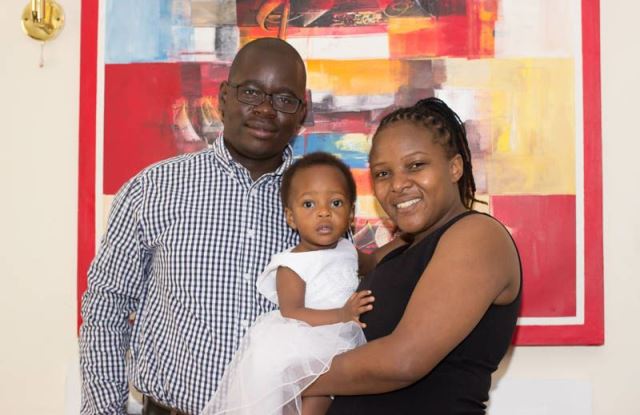
Dru, her husband and their son. Photo courtesy: #GodHealDru on Facebook

A few weeks ago, my timelines were filled with the hashtag #GodHealDru. It was hard not to follow the conversation. I didn’t know Dru, but I got to find out that she was a beautiful 34-year-old mom fighting for her life at a Mombasa hospital as a result of pregnancy complications. Her story was so emotional, with the hashtag peppered with stunning photos of her pregnancy, her adorable three-year-old son and her husband. They were such lovely family photos, filled with great joy and happiness. It was so heartbreaking to learn that Dru was fighting for her life as she was in the process of giving life.

Shortly thereafter, photos of her newborn son accompanied the hashtag. Also blood appeals for Dru, who was now in critical condition. Soon, information that Dru was no more began being shared. The news was hard to swallow. I had so much hope that she would make it.

Now, whenever I learn of the news of a woman’s death –especially a death as a result of pregnancy or childbirth complications, it takes me to a certain place. A place so dark, a place full of apprehension. And to be honest, fear. A place where I get to better understand the fragility of life. One moment you’re celebrating life, celebrating forthcoming life, the next minute it’s all darkness. It sadly makes me deeply reflect on the saying that goes like: “A Pregnant Woman has One Foot in the Grave’.

So what happened to Dru, that led to her death?

Below, I share excerpts from Eunice Kilonzo’s narration of Dru’s story in the Daily Nation.

Dru, her husband and their son. photo sourced from: #GodHealDru on Facebook

Druscillah Walowe Mngoda, popularly known as Dru, was wife to Dan Kinyanjui. Her husband says that on the night of Saturday 20 May, they arrived home after an awesome evening at a friend’s place.

“We went to bed, but at 1am she woke up complaining of heartburn. She wanted to brush it off, but when she threw up I immediately rushed her to Nyali Healthcare in Nyali, where we were ably assisted before being referred to Aga Khan Hospital for admission,” Dan says.

While at admissions, Dan heard the four words that would forever change the course of his life and that of his two sons.

Maternity Wing, Code Purple! Someone bellowed from down the corridor.

“I rushed there to find my Babe convulsing,” he says, using the affectionate name, Babe, to refer to his wife of six years. “She was in a fit and foaming, and once she was stabilized I signed the consent forms for her to go for emergency Caesarian section.”

Doctors told him the fit was indicative of high blood pressure complications during pregnancy, referred to in medical terms as eclampsia. If unmanaged, it could destroy the liver, kidneys and even the brain.

What Dru was going through was a severe complication of pre-eclampsia, a condition that affects some pregnant women, usually after the 20th week or the second half of pregnancy, or soon after their baby is delivered.

Also Read: Preeclampsia: All You Need to Know

Dru, who had celebrated her 34th birthday on May 13, and who had just walked into the hospital unassisted, was now motionless after a series of convulsions and violent shaking. Doctors surgically removed the baby — Dan named him Darrell — and, as they wheeled the little chap out of theatre, another team wheeled the mother into the Intensive Care Unit of the hospital. She had slipped into a coma.

In the morning the hospital made an O+ blood donation request. Dru required fresh platelets — the blood cells that aid in clotting — as her body was not producing any. This is because at this point the pre-eclampsia was progressing to a life-threatening syndrome called Hemolysis, Elevated Liver Enzymes and Low Platelets (HELLP).

Dru had suffered a brain aneurism — a bulging, weak area in the wall of an artery that supplies blood to the brain — due to the high blood pressure. That means the blood pressure was so high that it exerted a force against the walls of her arteries that was high enough to damage them and other blood vessels.

This damage restricted blood flow, leading to a swelling in the blood vessels in Dru’s brain and interfered with its ability to function, which explains the seizures.

Dan says the blood in his wife’s brain caused coning — the squeezing of the brain and brain stem through the foramen magnum (the hole in the base of the skull through which the spinal cord passes) as a result of swelling — which led to brain death. Eventually, Dru’s heart stopped.

You can read the full story at the Daily Nation. May God comfort her husband, her sons, her family, friends, and all those whom she touched. May God’s favor be upon the dear ones she has left behind.

I have previously written the stories of other moms who have preeclampsia experiences. Some survived with their babies, some lost their babies, while other moms like Claris did not make it while her son survived. You can read their stories in the links below, and share them with a friend to create more awareness about this dangerous pregnancy condition.

Helen-Njoroge-c

I Survived Preeclampsia, but my Baby did Not” -Helen Njoroge’s Story

Mercyline_1-640x426

Mercyline Chemutai: My Experiences with Preeclampsia, a Blighted Ovum, Pregnancy Losses and Faith in God

Carol_Gachii_e (1)

“The Day I Almost Lost my Life” -Caroline Gachii

Jane-Minoo-1

“I Trusted my Doctor Too Much: How I Survived Preeclampsia but Lost My Baby” -Jane Minoo

Claris_Ojwang2

George Ojwang Remembering His Dear Wife Claris, Two Years On

Doryce-Olough-with-son2-448x250 (1)

Doryce Olough: I Lost my Baby to Pre-eclampsia

Mary_Naanyu_5

“I Spent Almost Half of my Pregnancy in Tears!” -Mary Naanyu

Lucy_Morangi_1

I Was Scared of Getting Pregnant Again because of my Previous Preeclampsia Experience” -Lucy Morangi

Mummy Tales is a blog dedicated to empowering its readers on different aspects of maternal and newborn health, as well as various issues surrounding motherhood and women. Read more motherhood experiences of Kenyan moms here. Follow Mummy Tales on: FACEBOOK INSTAGRAM TWITTER 

Raising a Special Needs Child in Kenya: “Why it Took me Years to Realize that My Son Could Neither Speak nor Hear” -Regina Wanjiru

1

Regina Wanjiru is a 43-year-old mother of four; two daughters aged 24 years and 19 years, and two sons aged 23 years and 16 years. I recently met Regina and today, I bring you her story, where she talks of her parenting journey, which includes raising Dennis, her special needs child. Regina’s story has lots of lessons to learn. May you be encouraged by her story. Read on…

When Regina gave birth to Dennis 16 years ago, she immediately knew something was wrong.

“I already had three children, so I knew the birthing process. So when Dennis didn’t cry immediately I delivered him, I knew there was a problem. I became worried, but this was relieved when three minutes later, Dennis let out a faint cry,” she remembers.

Prolonged Labor

It had been a long journey to delivery for Regina. On her Expected Due Date (EDD), she had gone to the hospital in what she believed was the onset of labor pains. But the nurses informed her that they were just false alarms, and told her to go back home.

Three times she went to the hospital –each time sure she was in labor, but each time, she was sent back home asked to return when ‘she was in real labor’.

Finally, at 42 weeks pregnant, exhausted and in pain, Regina went to the hospital and this time round, she was more firm.

“I told the nurses I wasn’t going to return home, come what may. I was too tired. I was induced and a few hours later, I delivered my son Dennis, who didn’t cry immediately after birth. The cause for the delayed cry, the nuses informed me, was that I had been in labor for too long and so he was tired. I remembered the times I had go the e to hospital ready to deliver, but kept being turned away. I felt so bad.”

Regina Wanjiru, talking about her motherhood experiences..

Brain Damage

After leaving the hospital with her newborn, life went on well, until four months later when once again, something about Dennis alarmed her.

“I noticed he wasn’t able to hold his head up without support. His head was always dropping to the side, as though his neck muscles were weak.”

Regina took Dennis to the hospital where for the next six months, he attended therapy two times a week. The therapy helped, and he was able to gain some measure of head control. But the tribulations were still not over. By the time he was celebrating his first birthday, Dennis was still unable to stand on his two feet –even with support.

“His legs would always be curled up, and he was unable to stretch or straighten them. His back was also very weak, and he was never able to sit up unassisted.”

When Regina took him to the hospital, she was told that Dennis may have suffered brain damage at birth –most likely because of her prolonged labor.

“I was casually informed that my child had cerebral palsy. I didn’t know what that was or what that meant, and no one took time to explain it to me. I didn’t even know to pronounce it. I left the hospital unaware of the long journey ahead of me.”

But more was yet to come.

Regina-Wanjiru-Mummy-Tales-4

Deaf and Dumb

When Dennis was three years old, his mother noticed something odd with his speech. It wasn’t as developed as his peers.

“All he ever did was smile, laugh and make sounds –but never produced a word.”

She took Dennis to hospital with th the se concerns. But the insensitivity of the nurse who attended to her is something she’ll never forget.

“Mama, wacha hata kuongea. Huyu moto wako haskii. Kwani hujawai jua hivyo wewe mama hiyo miaka yote?” (Your son doesn’t only have a speech problem, but he is also deaf. Haven’t you ever figured that out all those years?), the nurse rudely said before dismissing her.

Those words pierced Regina so deep…

Continue Reading Next Page

House Helps in Kenya: “I’ve Had my Fair Share of Challenges with them” -Vellah Murengu’s Story

0

30 year old Vellah Murengu is a mother of two; 7-year-old daughter Edel and 4 year-old son Larveen. A Legal Assistant in an NGO, Vellah talks about some of her motherhood experiences, as narrated to Mummy Tales writer SYLVIA WAKHISI.

“Life as a mother has been very eye-opening for me, based on the different experiences I have gone through. Starting with the pregnancies. Both of my pregnancies were characterized by different experiences, including weird cravings and developing a dislike for certain things and people.

With my first child Edel, I remember disliking food. Would you believe that all I ever seemed to drink was Krest (the soda) and eat roasted clay? (don’t ask). I would buy the small pack of roasted clay for Sh50 from the supermarket twice or thrice a day, and happily munch on them. At the same time, I had low haemoglobin levels in the early months of pregnancy. The doctor told me to consume lots of beetroot for this, though I absolutely detested it.

Interestingly, with my second pregnancy, I loved all foods and ate almost everything. My only issues were lots of back ache and swollen feet. I even has to be put on bed rest at some point.

Life as a New Mom

Before the arrival of my daughter, I read lots of articles on motherhood and had lots of conversations with my friends who were already moms. By the time I was due, I had immense knowledge on motherhood. That notwithstanding, I still was very anxious, but I managed to go through new motherhood just fine. I thank God because I never had issues with my babies in the first three months as is usually the case with newborns. I would sleep through the night and only wake up to breastfeed.

Vellah with her children.

House Girl Challenges

When it comes to house girls, my experience is similar to that of many other moms. It’s not an easy journey. There is a time you wake up in the morning to go to work and she tells you that she is leaving! You ask yourself so many questions but you have to remain calm and think fast on what to do next because you can’t force her to stay when she has already made up her mind. When it comes to house girls, I have had my share of ups and downs with them…

Continue Reading Next Page
This Was My Difficult Experience Searching for a Particular Prescription Drug

0
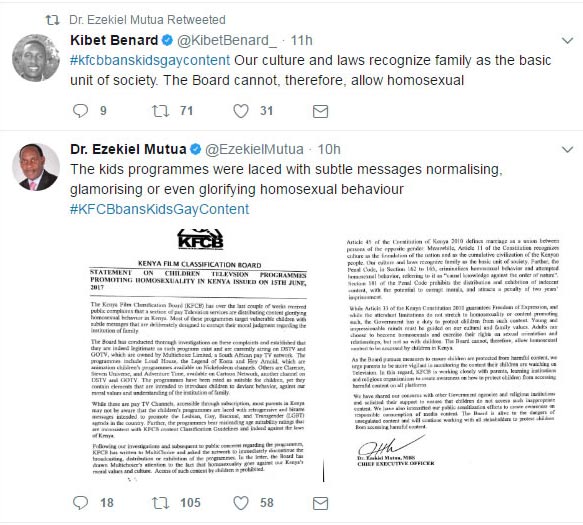
photo: africa knows

There’s a time early this year I kept moving from pharmacy to pharmacy looking for a drug the Dermatologist had prescribed for my son’s eczema flare up.

The Dermatologist had prescribed three different drugs but for some reason, there was that one particular drug that was out of stock in all the pharmacies I went to. Yet, I couldn’t start him on the other two –without that critical missing one.

Thing is, in this Nairobi, moving from one place to another can be quite an experience. You spend a significant amount of time in traffic just to get to your destination. If you’re driving, many pharmacies are located in places where nowadays you have to pay parking fees –whether in malls, hospitals, or in the City Council slots. Then, when you finally get to where the pharmacy is located, you spend endless minutes searching for a parking spot or double parked, waiting for one to open up.

Nairobi traffic.
Nairobi traffic.

Finally, relieved, you get to the pharmacy. But then, you most likely spend more time in the queue waiting for your turn to be served. By the time you’re done with the whole process, you’ve spent almost an hour –or more. Or sometimes when you learn the price of the drug, you feel as though it’s on the higher side, so you decide to compare prices first with at least two or three more pharmacies before you make a decision. Other times, after a long wait in the queue, your turn finally arrives, only to be informed that the drug is out of stock.

That happened to me when I was searching for my son’s eczema prescription. After quite an arduous search for that specific drug that spanned days, I eventually found a pharmacy that had it –actually the last pack! I was so relieved and did a small happy dance.

But my jubilation was short-lived when I was alerted of a new problem.

It had been slightly over a week since the Dermatologist had written the prescription, and so the Pharmacist couldn’t dispense the drug. I was told that I had to go back to the Dermatologist again and get a fresh prescription. Seven days had already passed, so they just couldn’t give me the drugs. Period.

I was mortified!

I tried to plead my case, saying that in fact the reason why I had delayed getting the drug ‘within the seven days’ was because I’d been moving from pharmacy to pharmacy searching for that elusive drug in vain. I didn’t even know there was a thing like that –that a prescription is only valid for seven days. Anyway, the Pharmacist actually sympathized with me, but said those were their pharmacy rules, and rules had to be followed. Sigh. So what I did was to request him to be kind enough to save that drug for me, because I’d be back.

Suffice it to say that I had to return to the Dermatologist. And plead for her not to charge me consultation fees for ‘seeing her’ again, and getting a fresh prescription.

Eventually I got the drug and my son got sorted, but I assure you that it was such an exhausting experience!

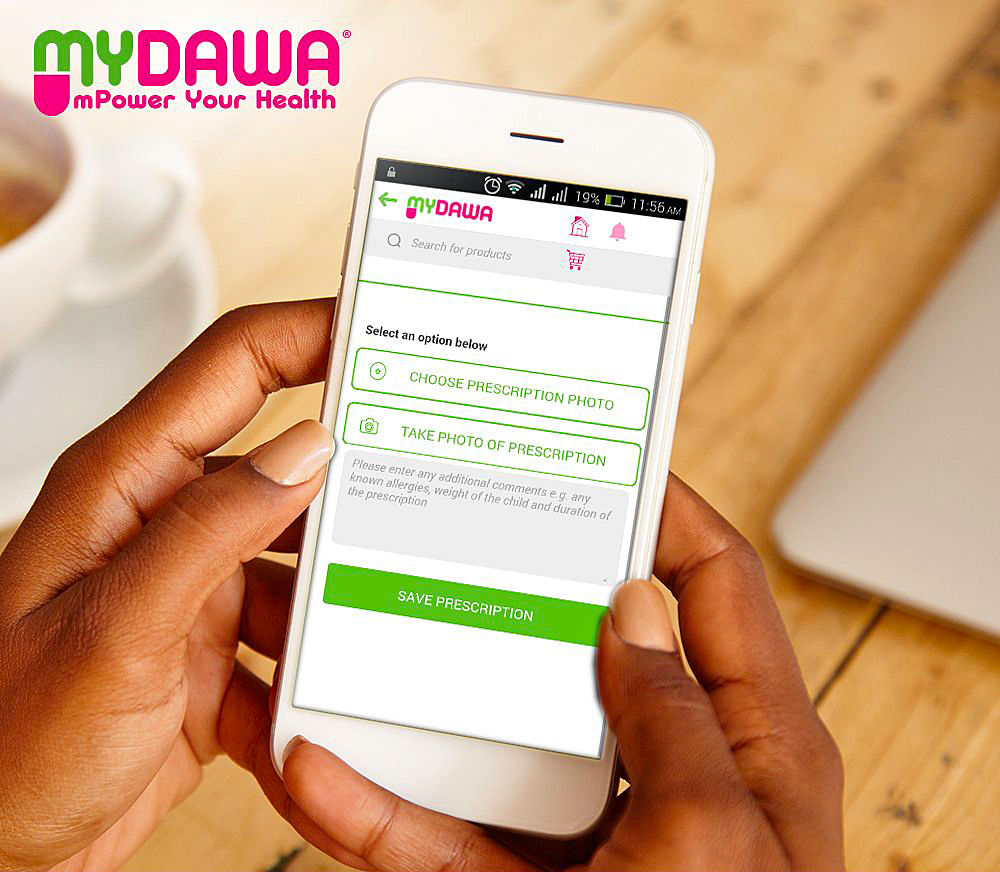
So it was with great relief when I recently came to learn about a new way of buying medicines that is so convenient, easy, and more importantly –time saving. I’m talking about MYDAWA, which is a new e-health service that enables you to purchase medicines at your own convenience. For example, if you have a prescription such as the one I had for my son’s eczema, you can just take a photo of it using your smartphone from wherever you are, then upload it. Once uploaded, the team at MYDAWA, who include pharmacists, will verify the details and get back to you shortly.

MYDAWA-mummy-tales-prescription-2

Once confirmed, they’ll package your order in a sealed tamper-proof bag with your name labelled on it, to ensure it reaches you safely. The sealed package containing your order (medicines and other health and wellness products you may have ordered) will then be dropped off at a pharmacy of your choice and convenience. You can choose the pharmacy nearest to you, your home, or your office where you can easily pick it at a time of your convenience, such as on your way home or during your office lunch-hour break. And by the way you don’t get charged any service fees, transaction or delivery costs.

This was such welcome news to me because next time I have a prescription, I don’t have to undergo the hassle I underwent, which was very time-consuming I must say.

So if you, just like me, would like to enjoy the safety, ease and convenience of purchasing prescription medicines, over-the-counter medicines, a wide range of health, wellness and beauty products among other items, and have them delivered at the nearest pharmacy to you so that you can pick them on your way home, then click on this link and sign up for the service. You can also download the MYDAWA App here. The App will make your online purchasing of drugs so much easier.

Indeed, with the numerous commitments that characterize our daily lives as women, as moms, MYDAWA is such a welcome relief.

MYDAWA-mummy-tales-pharmacist

So, have you ever had an experience moving from pharmacy to pharmacy searching for a drug, in vain? What did the experience feel like?

For more information about MYDAWA, visit the Website: www.mydawa.com or Facebook: MYDAWA or Twitter: @MyDawaApp

Raising a Special Needs Child in Kenya “Other Parents Complained about my ‘Nuisance’ Son and Urged the Head Teacher to Expel Him”

3
Stella Mwaromo

35-year-old Stella Mwaromo is a mother of three; two daughters aged 16 years and 6 years, and her 13-year-old son Rogers. I had a chat with Stella on her experiences as a mother, focusing more on raising a special needs child. Her son Rogers has epilepsy and intellectual disability. Read on…

One day, as Stella Mwaromo bathed her five-month old son Rogers, he suddenly began shivering and shaking uncontrollably. Assuming that he was feeling cold, she immediately got him out of the water and quickly covered him up.

A few days later, the shivering and shaking started again, but this time round, Rogers wasn’t being bathed. It wasn’t even cold, so Stella wondered what could be wrong. He didn’t have a fever either.

“I just held him in my arms as he continued trembling, until he went calm on his own,” remembers Stella.

However, the ‘shivering and shaking’ episodes continued over the next few weeks, prompting Stella to seek medical treatment.

Brain Damage

At the hospital, the doctor took his birth history and sent them for some tests, including an electroencephalogram (EEG). She was then informed of the diagnosis.

“The doctor said Rogers had ‘some extent of brain damage’. At birth, Rogers had been diagnosed with severe jaundice, and had stayed in hospital for one month undergoing treatment. The doctor explained that the jaundice could have been responsible for the brain damage, hence the regular ‘shivering and shaking’ which he told me were called seizures.” she says.

Stella_Mwaromo-2

Rogers stayed in hospital for almost two months, undergoing treatment. But even after being discharged, he would keep falling sick every so often to the extent that Stella, who was an Early Childhood Development (ECD) teacher, was unable to return to work after maternity leave.

“He was a sickly child, and we were always in and out of hospital. Later on I was even told he had epilepsy. Focusing on anything else other than Rogers became difficult,” she says.

But as Rogers continued to grow, Stella and her husband noticed something else about him.

“Rogers was a very active child –way more active than his peers. He was rough, aggressive and never be able to sit still. He also had a very short attention span and would do things impulsively.”

With this kind of erratic behaviour, his education became a great challenge.

“It was very difficult to retain him in any school. The teachers would always call me, telling me that my son was ‘too much’. Apparently, Rogers would disturb other children, snatch their crayons, their snacks, bully them, get into fights and was basically very disruptive. His behaviour was also very unpredictable and the teachers never knew what he would do next. He was too much too handle, they would say, before asking us to withdraw him from their school.”

Any school that Stella and her husband would enroll their son, there would always be complains about his behaviour.

Many times, Rogers would stay home as his parents looked for a new school. It was never easy, Stella says, since all the schools in the neighborhood had heard about Rogers, with none willing to accept him.

Disaster struck when one day, during one of those periods he was out of school, Rogers, aged six years, was walking to the shop together with the house girl who was holding his hand.

“He suddenly released himself from the house girl’s grip and bolted into the road and was hit by a motorbike. He ended up in the ICU, in a coma and with broken limbs.”

At that time, Stella was eight months pregnant with her third child…

Continue Reading Next Page
Advertisement

POPULAR POSTS

error: Not Allowed