Home Blog Page 2

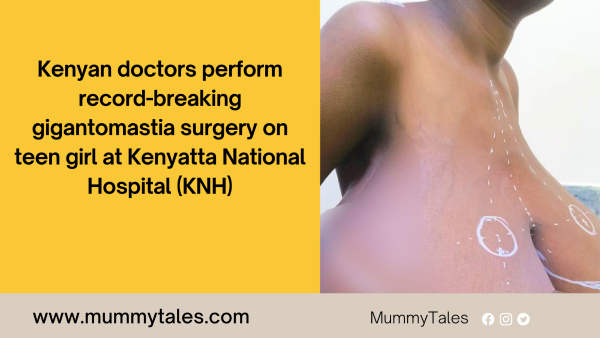
Kenyan doctors perform record-breaking gigantomastia surgery at Kenyatta National Hospital

0
gigantomastia surgery Kenya
Photo: KNH.

A team of dedicated surgeons and medical staff at Kenyatta National Hospital (KNH) have given a 17-year-old girl the gift of a normal life. In a landmark procedure believed to be the largest of its kind in the world, the team successfully removed 20.86 kilograms of breast tissue from Lydia Musivi, who suffered from a severe and rare condition known as gigantomastia.

By Maryanne W. Waweru I maryanne@mummytales.com

17-year-old Lydia Musivi from Mwingi, Kitui County, can now smile again, thanks to a dedicated team of doctors at the Kenyatta National Hospital (KNH) who performed a record-breaking surgery that has changed her life forever.

For 18 months, Lydia lived with a rare condition known as gigantomastia, which caused her breasts to grow uncontrollably. The weight, which was equivalent to 37% of her body mass, made her every movement to be excruciatingly painful. Walking, standing, and even breathing were a struggle for the teenager. Sadly, Lydia had to drop out of school as the weight of the burden she was carrying was too much.

But on September 22, 2025, Lydia’s life turned around. A team of doctors led by Dr. Benjamin Wabwire, Head of Specialized Surgery and Consultant Plastic and Reconstructive Surgeon at KNH, in a highly complex surgery successfully removed 20.86 kilograms of breast tissue from her. This is a world record for the largest gigantomastia surgery ever performed.

When Lydia woke up from the 11-hour surgery, she said she felt “free, lighter, and ready to return to school.” Her dream of becoming a high school teacher also seemed possible again.

The relief was also felt by her mother, Naomi Mutendwa, who had spent months searching for help as she witnessed her daughter’s health and confidence fade away.

“I watched my daughter disappear under the weight of this illness. We felt hopeless until we were referred to KNH from Garissa County Referral Hospital. The KNH team saw the girl, not just the condition. They didn’t just treat her; they gave me back my daughter. They have given her a second chance at life,” she said.

Lydia has now been discharged and is recovering well. Come January 2026, she plans to return to school and continue with her studies, her dream of becoming a teacher stronger than ever.

Source: KNH.

Have you or someone you know faced a life-changing medical journey? Share your experience in the comments or email me at maryanne@mummytales.com -your story could inspire another woman to keep going.

Mummy Tales by Maryanne W. Waweru is a platform dedicated to empowering its readers on different aspects of womanhood and motherhood. Read more motherhood experiences of Kenyan moms here. Connect with Mummy Tales on: FACEBOOK l YOU TUBE l TWITTER

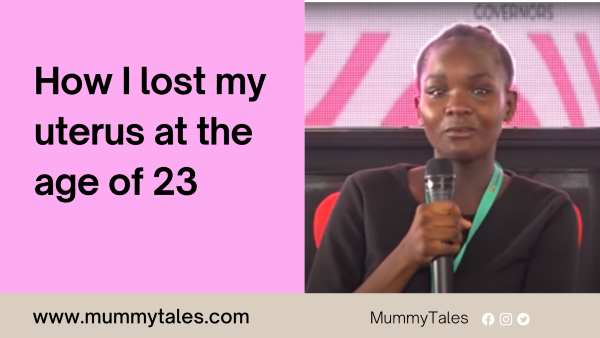
How a young Kenyan mother, Stacy Adhiambo, lost her uterus at just 23

0
Stacy Adhiambo photo screengrab: Defrontera

At only 23 years old, Stacy Adhiambo faced every mother’s worst nightmare; a childbirth emergency that cost her her uterus. Despite following all medical advice and doing everything right, a series of delays and system failures during labor nearly claimed her life. Stacy’s story is a reminder of the urgent need to strengthen maternal healthcare in Kenya.

By Maryanne W. Waweru l maryanne@mummytales.com

Stacy Adhiambo, a young mother from Homa Bay County in western Kenya, went through childbirth complications that changed her life forever. At just 23 years old, she lost her uterus despite having done ‘everything right’ during her pregnancy.

From the moment she discovered she was expecting, Stacy was thrilled. Her pregnancy was smooth, and she faithfully attended all her antenatal clinic appointments. She followed medical advice and took every precaution to ensure both her safety and that of her baby. Stacy eagerly looked forward to a safe delivery and a healthy baby.

When labour pains began, Stacy knew what to do. She went to Makongeni Sub-County Hospital, Homa Bay, at around 7am, where she was told she was already 9 cm dilated. However, her labour soon developed complications, prompting an emergency referral to Homa Bay Teaching and Referral Hospital (HBTRH).

But what should have been a swift transfer turned into a harrowing ordeal. It took nearly an hour for the ambulance to arrive and when it finally did, it ran out of fuel just outside the hospital gate. Stacy was forced to pay KSh 1,000 (about USD 7.80) so that the driver could fetch fuel by motorbike. This caused yet another 30-minute delay.

By the time she reached HBTRH at around 10:30am, Stacy was in immense pain. At midday, she was fully dilated but still unable to deliver. Doctors recommended an emergency caesarean section. Yet even then, she had to wait several more hours because no surgical team was immediately available. Stacy only entered the operating theatre at 5pm.

Uterine rupture in Kenya

While her baby was safely delivered, Stacy’s ordeal was far from over. She began bleeding profusely due to a uterine rupture, a life-threatening complication. Doctors had no choice but to perform an emergency subtotal hysterectomy. This is a procedure that involves removal of the uterus while leaving the cervix intact, primarily to save the mother’s life.

Also read: Magdalene Mburu’s death from uterine rupture complications

As Stacy was moved from the recovery room to the ward, she faced yet another challenge: there was no blood available for transfusion. In desperation, she and her family had to mobilize friends and relatives to donate blood, as the hospital also scrambled to source some.

Maternal health in Kenya

Stacy’s experience is a painful reminder of how multiple small delays can add up to life-threatening consequences. A lack of ambulance fuel, delayed surgery, staff shortages, and inadequate blood supplies all compounded to create a near-tragic outcome.

Her story underscores the reality that even when a woman does ‘everything right’ during pregnancy, systemic failures within the healthcare system can still lead to devastating results.

Thankfully, Stacy survived to tell her story. Many other mothers are not as fortunate.

Information source: Defrontera.

Also read: A teenage mother in Kenya nearly lost her life in childbirth -here’s how we saved her

If you would like to share information about maternal health in Kenya, you may reach me at maryanne@mummytales.com

Mummy Tales by Maryanne W. Waweru is a platform dedicated to empowering its readers on different aspects of womanhood and motherhood. Read more motherhood experiences of Kenyan moms here. Connect with Mummy Tales on: FACEBOOK l YOU TUBE l TWITTER

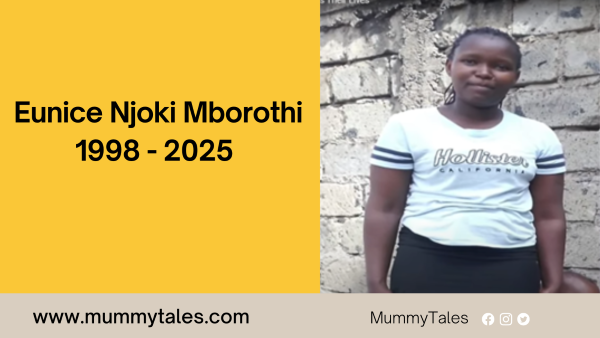
The circumstances surrounding the maternal death of Eunice Njoki

0
maternal-deaths-in-Kenya
The late Eunice Njoki. Photo: screengrab, Citizen TV Kenya

This article highlights the maternal death of 27-year-old Eunice Njoki Mborothi, who passed away after developing childbirth complications in a Nairobi hospital. This is story eleven in the Wanjiku Kumbukumbu series by Mummy Tales, an initiative that is documenting maternal deaths in Kenya. 

By Maryanne W. Waweru l maryanne@mummytales.com

Eunice Njoki Mborothi, 27, and her husband eagerly awaited the birth of their third child. According to her husband, Samuel, she diligently attended her antenatal clinics at Kayole II Level 4 Hospital in Nairobi. The facility had also assured the couple that it was fully equipped to manage her delivery, and she was booked to give birth there.

Samuel recalls that the doctors had identified Njoki’s pregnancy as high-risk from as early as her third month. Because of this, the medical team monitored her closely throughout her pregnancy. By the time her delivery date arrived, she had been given a clean bill of health, giving reassurance to the young couple as they prepared to welcome their baby.

On 30 August 2025, Njoki delivered a healthy baby girl. However, moments after childbirth, she began to bleed heavily. Despite the prior awareness of her high-risk status and the reassurances that her delivery would be well-managed, Samuel says the team at Kayole II Level 4 Hospital appeared unprepared for the emergency.

Njoki was then referred to Mama Lucy Kibaki Hospital, located about five kilometres away. Sadly, less than an hour after her arrival, Samuel was informed that his wife had passed away.

Could Njoki’s death have been prevented?

Watch Samuel’s narration of the events below.

The unfortunate death of Njoki is the eleventh account in the Wanjiku Kumbukumbu series by Mummy Tales, an initiative that is focused on documenting maternal deaths in Kenya to raise awareness about the issue and advocate for better maternal health. The project aims to memorialize Kenyan mothers we have lost to childbirth complications. 

Read more Wanjiku Kumbukumbu articles:

  1. Phyllis Wanjiru, 33, succumbs after caesarean section complications
  2. Faith Binzali, 26, succumbs to a caesarean section gone wrong
  3. Mumbi’s death from retained placenta complications
  4. Barbara Mkok, 38, succumbs to pre-eclampsia complications
  5. Stella Mtira Wangama, 33, succumbs to post-caesarean section complications
  6. Magdalene Njoki Mburu, 36, and her death from uterine rupture complications
  7. Immaculate Akinyi Kirui, 40, dies from childbirth complications 
  8. Elizabeth Wairimu, 27, dies from pulmonary embolism
  9. Phanice Kerubo, 27, dies from alleged neglect while in labour at hospital  
  10. Vanessa Wanjiku, 26, dies after caesarean section delivery 

If you would like to share information about a mother who has lost her life due to maternal health complications in 2025, or if you would like to support the Wanjiku Kumbukumbu project by Mummy Tales, please reach me at maryanne@mummytales.com

Mummy Tales by Maryanne W. Waweru is a platform dedicated to empowering its readers on different aspects of womanhood and motherhood. Read more motherhood experiences of Kenyan moms here. Connect with Mummy Tales on: FACEBOOK l YOU TUBE l TWITTER


Phyllis Wanjiru’s death after Caesarean section: documenting maternal deaths in Kenya

0
maternal-deaths-in-Kenya
The late Phyllis Wanjiru, who succumbed to caesarean section complications. Photo courtesy: Joseph Wanyonyi on X.

This article highlights the maternal death of Phyllis Wanjiru, a young Kenyan mother who passed away after developing complications from a caesarean section delivery. This is story ten in the Wanjiku Kumbukumbu series by Mummy Tales, an initiative that is documenting maternal deaths in Kenya. 

By Maryanne W. Waweru l maryanne@mummytales.com

Every day, 13 women in Kenya lose their lives to pregnancy and childbirth-related complications. Each day, 13 families are left grieving the loss of a loved one who died while bringing new life into the world. One such family is that of 33-year-old Phyllis Wanjiru, who tragically passed away on 10 September 2025 from childbirth complications.

According to her husband, Joseph Wanyonyi, Phyllis developed complications after undergoing a caesarean section at St. Teresa Hospital in Kikuyu, Kiambu County. He says that while his wife successfully delivered their beautiful baby girl, she began bleeding heavily after the surgery, an emergency situation that necessitated her transfer to Kenyatta National Hospital (KNH).

Sadly, Phyllis did not survive.

A postmortem conducted on 15 September 2025 revealed that Phyllis died from excessive bleeding. She likely suffered postpartum haemorrhage (PPH) -severe blood loss after childbirth. PPH is the leading cause of maternal deaths in Kenya. Sadly, most PPH-related deaths are preventable.

Wanyonyi has since accused St. Teresa Hospital, Kikuyu of alleged medical negligence. He believes his wife’s death could have been prevented. The matter is now under investigation.

Deaths from caesarean sections in Kenya

Phyllis’s story is not an isolated tragedy. Just two weeks ago, Faith Binzali, 26, similarly died from caesarean section complications at St. Joseph the Worker Catholic Health Center in Kangemi, Nairobi County. Postmortem results revealed that Faith died from hypoxia (lack of oxygen), likely caused by the anaesthetic drug administered on her.

The deaths of these two young mothers are a sad, stark reminder of the urgent need to strengthen maternal healthcare systems in Kenya. This, in a bid to ensure that no woman dies while giving life, and that no family has to endure such heartbreak.

The unfortunate death of Phyllis is the tenth account in the Wanjiku Kumbukumbu series by Mummy Tales, an initiative that is focused on documenting maternal deaths in Kenya to raise awareness about the issue and advocate for better maternal health. The project aims to memorialize Kenyan mothers we have lost to childbirth complications. 

Read more Wanjiku Kumbukumbu articles:

  1. Faith Binzali’s death from caesarean section gone wrong
  2. Mumbi’s death from retained placenta complications
  3. Barbara Mkok’s passing from pre-eclampsia complications
  4. Stella Mtira Wangama’s death from post-caesarean section complications
  5. Magdalene Njoki Mburu’s passing from uterine rupture complications
  6. Mwalimu Immaculate Akinyi Kirui’s death from childbirth complications after delivering quadruplets 
  7. Elizabeth Wairimu’s death from pulmonary embolism at age 27
  8. Phanice Kerubo, 27, dies from childbirth complications 
  9. Vanessa Wanjiku’s death while giving life 

If you would like to share information about a mother who has lost her life due to maternal health complications in 2025, or if you would like to support the Wanjiku Kumbukumbu project by Mummy Tales, please reach me at maryanne@mummytales.com

Mummy Tales by Maryanne W. Waweru is a platform dedicated to empowering its readers on different aspects of womanhood and motherhood. Read more motherhood experiences of Kenyan moms here. Connect with Mummy Tales on: FACEBOOK l YOU TUBE l TWITTER

Kenyan woman dies after Caesarean section goes wrong: documenting maternal deaths in Kenya

0
Faith-Binzali
Faith's husband, Alex Ndung'u (in black jacket) mourns her loss. Photo credit: The Standard.

This article highlights the maternal death of Faith Binzali, a young mother who passed away on the operating table while undergoing a caesarean section delivery. This is story nine of the Wanjiku Kumbukumbu project by Mummy Tales, an initiative that is documenting maternal deaths in Kenya. 

By Maryanne W. Waweru l maryanne@mummytales.com

What was meant to be a joyful moment for 26-year-old Faith Binzali and her family quickly turned into tragedy when she died on the operating table while undergoing a caesarean section delivery at St. Joseph The Worker Catholic Health Centre in Kangemi, Nairobi County. Faith passed away on Tuesday 2 September 2025. It was her first child.

Her husband, Alex Ndung’u, said that his wife walked into the health facility in good health and with no complications. Sadly, she was never to return home.

Her father, Bernard Babu, believes her death was the result of medical negligence, saying that the staff’s poor handling of the procedure caused a preventable tragedy.

When Bernard entered the operating room, he was met with a horrific scene. Blood was splattered across the walls and floor, with his daughter’s lifeless body soaked in blood. Bernard also noted that blood was spilling from her mouth.

According to Bernard, the health workers offered no explanation to the grieving family about what had transpired. Instead, they fled the hospital, leaving Faith’s loved ones devastated and traumatized.

Autopsy report on Faith Binzali

A postmortem on Faith conducted on 4 September 2025 established that she died from lack of oxygen in the brain (hypoxia) while on the operating table –a likely complication from the anaesthetic drug that was administered to her. It is reported that excessive anaesthetic drugs were used on her, in addition to an overdose of other drugs given to her before the surgery.

The family has since reported the matter to the police.

13 Kenyan women die daily from pregnancy-related and childbirth complications. Sadly, most of these deaths are preventable.

It is worth noting that St. Joseph The Worker Catholic Health Centre had previously been blacklisted by the now-defunct National Health Insurance Fund (NHIF) over false claims.

*The above information’s source is KTN News Kenya. Watch the videos below for more details.


The unfortunate death of Faith is the ninth account in the Wanjiku Kumbukumbu series by Mummy Tales, an initiative that is focused on documenting maternal deaths in Kenya to raise awareness about the issue and advocate for better maternal health. The project aims to memorialize Kenyan mothers we have lost to childbirth complications. 

Read more Wanjiku Kumbukumbu articles:

  1. Mumbi’s death from retained placenta complications
  2. Barbara Mkok’s passing from pre-eclampsia complications
  3. Stella Mtira Wangama’s death from post-caesarean section complications
  4. Magdalene Njoki Mburu’s passing from uterine rupture complications
  5. Mwalimu Immaculate Akinyi Kirui’s death from childbirth complications after delivering quadruplets 
  6. Elizabeth Wairimu’s death from pulmonary embolism at age 27
  7. Phanice Kerubo, 27, dies from childbirth complications 
  8. Vanessa Wanjiku’s death while giving life 

If you would like to share information about a mother who has lost her life due to maternal health complications in 2025, or if you would like to support the Wanjiku Kumbukumbu project by Mummy Tales, please reach me at maryanne@mummytales.com

Mummy Tales by Maryanne W. Waweru is a platform dedicated to empowering its readers on different aspects of womanhood and motherhood. Read more motherhood experiences of Kenyan moms here. Connect with Mummy Tales on: FACEBOOK l YOU TUBE l TWITTER

How complications from a retained placenta claimed Mumbi’s life: documenting maternal deaths in Kenya

0
maternal-death-stories-in-Kenya

By Maryanne W. Waweru l maryanne@mummytales.com

In June 2025, a young mother, Mumbi, lost her life in a hospital in Mukurweini, Nyeri county, after delivering her baby. According to Mumbi’s cousin, the admission process when she arrived at the hospital at night went smoothly. Her labour also progressed well, which led to the birth of her daughter. She had a vaginal delivery.

However, the delivery of the placenta after Mumbi’s vaginal birth presented a challenge, as it appeared to be a case of a ‘retained placenta’. This happens when the placenta (or parts of it) remains in the uterus after delivery, failing to be expelled within a certain timeframe (usually from 5 – 30 minutes). If not managed well, a retained placenta can lead to life-threatening blood loss (postpartum haemorrhage (PPH) or severe infection. The consequences can be fatal.

Sadly, a few hours after delivery, Mumbi lost her life. She suffered excessive blood loss. Her newborn daughter survived.

According to her cousin, the family believes that Mumbi could have been better managed by the attending clinicians when the complication of the retained placenta arose. The family alleges that Mumbi’s life could have been saved had her situation been treated with the emergency care that it deserved. Listen to Mumbi’s cousin narrate the incident that led to her demise below.

@hellennjeri42

♬ original sound – bi.Maina

13 Kenyan women die daily from pregnancy-related complications. Sadly, most of these deaths are preventable.

The unfortunate death of Mumbi is the eighth account in the Wanjiku Kumbukumbu series by Mummy Tales, an initiative that is focused on documenting maternal deaths in Kenya to raise awareness about the issue and advocate for better maternal health. The project aims to memorialize Kenyan mothers we have lost to childbirth complications. 

Read more Wanjiku Kumbukumbu articles:

  1. Barbara Mkok’s passing from pre-eclampsia complications
  2. Stella Mtira Wangama’s death from post-caesarean section complications
  3. Magdalene Njoki Mburu’s passing from uterine rupture complications
  4. Mwalimu Immaculate Akinyi Kirui’s death from childbirth complications after delivering quadruplets 
  5. Elizabeth Wairimu’s death from pulmonary embolism at age 27
  6. Phanice Kerubo, 27, dies from childbirth complications 
  7. Vanessa Wanjiku’s death while giving life 

If you would like to share information about a mother who has lost her life due to maternal health complications in 2025, or if you would like to support the Wanjiku Kumbukumbu project by Mummy Tales, please reach me at maryanne@mummytales.com

Mummy Tales by Maryanne W. Waweru is a platform dedicated to empowering its readers on different aspects of womanhood and motherhood. Read more motherhood experiences of Kenyan moms here. Connect with Mummy Tales on: FACEBOOK l YOU TUBE l TWITTER

Barbara Mkok’s passing from childbirth complications: Documenting maternal deaths in Kenya

0
Barbara-Mkok

Barbara Aoko Mkok, a Kenyan mother aged 38, passed away following childbirth complications after delivering her baby at the Kenyatta National Hospital (KNH) on 19 June 2025. Barbara succumbed to pre-eclampsia complications that led to kidney failure, which contributed to her untimely demise.

In Kenya, pre-eclampsia (high blood pressure in pregnancy) is the second leading case of maternal deaths. The leading cause of maternal deaths is post-partum haemorrhage (PPH) or excessive bleeding after childbirth.

The unfortunate death of Barbara Aoko Mkok is the seventh of the Wanjiku Kumbukumbu series by Mummy Tales, an initiative that is focused on documenting maternal deaths in Kenya to raise awareness about the issue and advocate for better maternal health. The project aims to memorialize Kenyan mothers we have lost to childbirth complications. 

Read more Wanjiku Kumbukumbu articles:

  1. Stella Mtira Wangama’s death from post-caesarean section complications
  2. Magdalene Njoki Mburu’s passing from uterine rupture complications
  3. Mwalimu Immaculate Akinyi Kirui’s death from childbirth complications after delivering quadruplets 
  4. Elizabeth Wairimu’s death from pulmonary embolism at age 27
  5. Phanice Kerubo, 27, dies from childbirth complications 
  6. Vanessa Wanjiku’s death while giving life 

If you would like to share information about a mother who has lost her life due to maternal health complications in 2025, or if you would like to support the Wanjiku Kumbukumbu project by Mummy Tales, please reach me at maryanne@mummytales.com

Mummy Tales by Maryanne W. Waweru is a platform dedicated to empowering its readers on different aspects of womanhood and motherhood. Read more motherhood experiences of Kenyan moms here. Connect with Mummy Tales on: FACEBOOK l YOU TUBE l TWITTER

Barbara’s photo credit: Daily Nation 26/06/25

A teenage mother in Kenya nearly lost her life in childbirth -here’s how we saved her

0

This is the story of a Kenyan teenage mother, Moureen, who survived two risky childbirth complications: high blood pressure (pre-eclampsia) and severe bleeding (post-partum haemorrhage). Her case is referred to as a ‘maternal near miss’, meaning a woman who nearly died but survived a severe complication/s during pregnancy, childbirth, or within 42 days of termination of pregnancy.

Moureen’s story is told by the clinician who attended to her during this delicate time in her life. The clinician, who has over 10 years of practice, requested to have her identity concealed. She however stated that her purpose of sharing this story is to enlighten the public on some of the circumstances that lead to maternal deaths in Kenya; how it happens that sometimes a mother’s life is lost while in hospital under the care of skilled attendants. This incident happened in April 2025.

This story is part of the ‘Wanjiku Kumbukumbu’ memorial board by Mummy Tales, an initiative that is documenting maternal deaths in Kenya. ‘Wanjiku Kumbukumbu’ aims to raise awareness about the issue and advocate for better maternal health.

By Maryanne W. Waweru I maryanne@mummytales.com  

“I am a Clinical Officer working in a small health center in rural Kenya –specifically in the western region. Our facility is mission-funded, though it is quite under-equipped if I may say so. However, we do our best to adequately serve every client.

I’d like to share a challenging situation that my colleagues and I recently faced, regarding the childbirth experience of a 17-year-old girl –let’s call her Moureen*.

Moureen got pregnant while in Form 3 and decided she did not want to continue with her studies anymore. Moureen and her siblings depend on their mother, who works as a casual labourer in people’s farms in the village. Moureen hardly sees her father as he is rarely ever home.

After dropping out of school, Moureen took to trading in kienyeji (traditional) vegetables in the local market, 2 kilometres away from her home.

Alarming blood pressure readings

One day, while I was working the night shift, Moureen arrived at the facility accompanied by her mother. That was at around 8:30pm. They had trekked to the facility. The nurse on duty documented her, prepared her file and booked her in.

After examining Moureen, the nurse informed me that she was in active labour, with her cervix dilated at 3cm. She also said that the baby was doing well.

However, the nurse was worried about something. Moureen’s blood pressure reading was 146/96, with a pulse of 98. The nurse was rightfully troubled, because this reading indicated hypertension in pregnancy (pre-eclampsia).

We took the pressure readings repeatedly. Unfortunately, they remained high.

Meanwhile, we also checked Mourine’s urine for proteins –another indicator of pre-eclampsia. There was none. While that gave us some relief, it did little to ease our worries.

Dilemma in referring the patient to a better-equipped facility

When I checked the time again, it was slightly past 9.00pm. We did not want to have an emergency in the middle of the night, and after critically assessing and analyzing the situation, we decided to refer Moureen to a better-equipped hospital. The county ambulance was not available, so we asked Moureen’s mother to look for transport money so we could call for a taxi to refer the patient to a better equipped hospital.

In the meantime, we started Moureen on anti-hypertensive drugs.

A few minutes later, when we got back to Moureen’s mother, we found her at the same spot we had left her. She looked up at us with pleading eyes, telling us that she did not have taxi money.

Hiring a taxi to the nearest county referral facility would have cost between 4,000 – 5,000 Kenyan shillings ($30 – $38). The high cost was because the facility is a long distance away –around 34 kilometres. We had made the decision to refer her to a public hospital where we were sure she would receive all the services she needed, and at an affordable cost. Moureen’s mother only had 200 Kenyan shillings ($1.5) on her.

While there are a handful of private hospitals along the way, and which are well-equipped, they are costly. Additionally, one is required to pay first before being attended to. This was not an option for Moureen’s mother.

There is also a public ‘level 4’ hospital in between, but they too refer emergency cases to the county referral hospital, especially at night because of staff shortage. So we were stuck.

We continued recording Mourine’s blood pressure every 30 minutes, but the readings kept rising despite our interventions. At 10.30pm, the blood pressure reading was at 188/110. We gave her medication to prevent seizures and an injectable anti-hypertensive drug.

An impromptu fundraising 

At that time, we were three staff at the facility. We conducted an impromptu harambee between us in an attempt to raise the required 4,000 shillings for the taxi. However, we did not even manage to raise 1,000 shillings.

Meanwhile, Moureen’s labour was progressing. We were also monitoring the baby, who was holding on well. Our worry was Moureen’s blood pressure that was not responding to the medication.

Rejection by a taxi driver

Desperate, we called our regular taxi driver to plead our case. We promised to give him all that we had and pay him later. However, he declined because we already had a previous debt with him. He insisted that we first settle that amount before he started his engine. There were no other trusted cab drivers at that hour that we could call.

Dejected, we gave up on the referral and decided to focus on monitoring the patient and managing the condition to the best of our ability.

Childbirth risks for teenage mothers

At midnight, Moureen’s blood pressure was still high. We knew what was at stake. We prayed for a miracle. Her labour nevertheless kept progressing ‘well’ and by 5.00am, her cervix was fully dilated. The membranes had ruptured, and the baby was in distress. While her blood pressure had slightly dropped to 154/96 –it was still high. Moureen was still ‘in the woods’.

We were now ready to deliver the baby. Moureen was only 17 years old –just a teenager, which predisposed her to more risk. But we felt confident about the task ahead of us.

The baby was crowning well, and the contractions were adequate. However, the labour had exhausted her, and she had no energy to push. Moureen passed out.

Her blood pressure shot up again at that point. We managed to bring her back and gave her some glucose. She regained some strength and with our support, she mustered all her energy to push, and we delivered the baby. It was chaotic, but we managed.

Another complication for Moureen

One thing about pre-eclampsia is that once the mother delivers the placenta, in most cases the blood pressure normalises, which is what happened with Moureen. However, we were not safe yet because she started bleeding heavily (post-partum haemorrhage).

We immediately administered a drug that stopped the bleeding in good time, saving her life.

Moureen’s son was born a healthy, bouncing baby weighing 3.5kgs. The birth of Moureen’s baby and their survival was nothing but a miracle.

When it was finally over, Moureen’s mum broke down in tears. While she had been present all along witnessing the events, she had remained silent, observing, praying, interceding. It was only when we told her that her daughter and grandson were safe that she burst into loud wails, shedding tears of relief. She had been tensed all along, and it showed in how she received the news.

Unqualified for SHA

Moureen is only 17, and without an Identity Card, she did not qualify for the government health insurance (social health authority -SHA) which would have catered for the delivery charges (read the June 2025 SHA update on teenage mothers here). Her parents did not have SHA insurance either.

Our childbirth delivery charges are fixed at 3,500 shillings. Moureen’s mother was unable to pay this amount. Moureen’s father, upon learning the news of his being a new grandfather later came to the facility and paid 200 shillings. Sometimes, we are forced to dig into our pockets to help families that cannot pay the full amount. However, on many occasions we ourselves are broke.

In cases such as this, we waive the balance because if the patient and their family genuinely don’t have the money because, what can we do?

While we have handled challenging maternity-related incidents at the health facility before, Moureen’s case is by far the most challenging one so far.

Our hope is that one day we will have our own ambulance and theatre, to enable us better handle emergencies such as Moureen’s.

If you would like to voluntarily provide information about a mother who has lost her life due to maternal health complications in 2025, or if you would like to support the WanjikuKumbukumbu project by Mummy Tales, please reach me at maryanne@mummytales.com

Read previous Wanjiku Kumbukumbu posts:

  1. Stella Mtira Wangama’s death from post-caesarean section complications
  2. Magdalene Njoki Mburu’s passing from childbirth complications (uterine rupture)
  3. Mwalimu Immaculate Akinyi Kirui’s death from childbirth complications after delivering quadruplets 
  4. Elizabeth Wairimu’s death while giving life at age 27
  5. Phanice Kerubo, 27, dies from childbirth complications 
  6. Vanessa Wanjiku’s death while giving life 

Mummy Tales by Maryanne W. Waweru is a platform dedicated to empowering its readers on different aspects of womanhood and motherhood. Read more motherhood experiences of Kenyan moms here. Connect with Mummy Tales on: FACEBOOK l YOU TUBE l TWITTER

Featured photo courtesy: Iwaria

“I developed allergies after pregnancy” -Carole Kobia
0
Kenyan-mothers

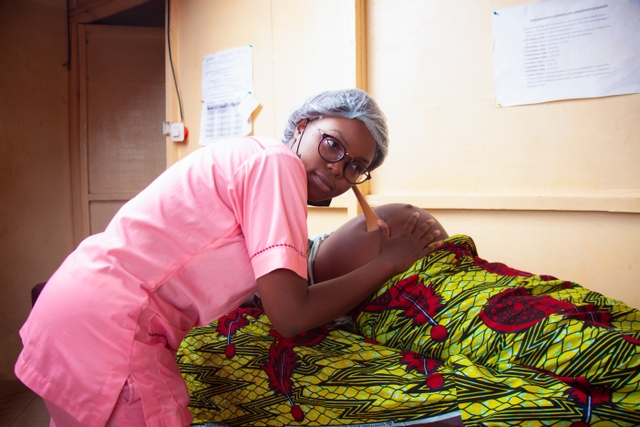
Carole Kobia, 32, is a Kenyan mother of two. In this article, she talks about the allergies she developed after her second pregnancy. She narrated her experience to MARYANNE W. WAWERU.

“I had my first baby at the age of 24, and it was a smooth pregnancy with no issues at all. I delivered my baby via caesarean section. My second pregnancy was similarly without any significant issues, and I also delivered via caesarean section. I got my second child at the age of 30 –actually, I delivered her on my 30th birthday!

Reaction to car smoke

I however noticed that after my second pregnancy, I started reacting to vehicle exhaust fumes. Whenever I would be in an environment of many vehicles with running engines, I would begin coughing heavily and running out of breath. My chest would close up and I would begin gasping for air.

This was strange, because I never used to experience that before. In fact, before my second pregnancy, I used to work in the Pangani area in Nairobi, and I would often walk to the Nairobi central business district (CBD) –a distance of about 4km. The trek, usually during rush hour, would mean me walking alongside heavy traffic –sometimes navigating my way in between vehicles. The fumes emitted by the vehicles would never affect me at all.

There was also a time that I used to work in the CBD doing sales and this would see me walk around the town center all day long. I would ‘interact’ with many vehicles and their emissions as I went about my sales job. This would not affect me.

Thankfully, I now work from home so my interaction with vehicles is minimal. In fact I fear going to town center. However, as it is inevitable that I sometimes have to go to the CBD or to places where there is a high concentration of vehicles, I have learnt how to adapt.

What I do is that I must wear a mask, which helps to protect my lungs from the vehicle fumes. In case I get an attack, I must sit down and drink some warm water. I have discovered that this helps relieve the temporary agony.

Carole Kobia, who developed post-pregnancy allergies. Photo courtesy -Carole Kobia

About two weeks ago, with the assumption that I had now overcome the allergy since it has been two years, I took my aunt for shopping along Ronald Ngala street in the CBD –a place that has a high concentration of vehicles, especially matatus. Big mistake!

I got a bad attack where I began coughing, wheezing and running out of breath. Thankfully, my aunt, together with good Samaritans helped me out of the attack. I will not dare risk this again for it is clear that I still have the allergy.

Allergy to cold weather

Something else that I discovered after my second pregnancy was that during the cold weather, my nose would become runny, and I would get all blocked up as my sinuses flared up. I would also sneeze repeatedly –something that never used to happen before. So whenever it’s cold, I must dress up very warmly.

I suspect my allergies developed with my second pregnancy because I gave birth at an older age –at 30. With my first pregnancy at 24 years, I never had any issues at all. I think having a baby as an older woman predisposes one to some issues that they otherwise wouldn’t have had if they had given birth when younger. This is my own theory though.

I once mentioned to my doctor about what I was experiencing, but he told me that ‘they are just allergies’. I went on to do my own research and discovered that some women develop such allergies after pregnancy, so I stopped worrying excessively.

I know my body well, and I know that these allergies came after my second pregnancy. I’m speaking out so that other woman can know that such allergies can arise after they get their babies, and for them not to think that they are alone.”

What is your experience? Did you develop any allergies after your pregnancy? Share your experience below, or you can email me on maryanne@mummytales.com

Read more about allergies after pregnancy here.

Mummy Tales by Maryanne W. Waweru is a platform dedicated to empowering its readers on different aspects of womanhood and motherhood. Read more motherhood experiences of Kenyan moms here. Connect with Mummy Tales on: FACEBOOK l YOU TUBE l TWITTER

Stella Mtira Wangama’s death from childbirth complications: Documenting maternal deaths in Kenya

0
Stella-Mtira-Wangama
Photo credit: The official Facebook page of Hon. Duncan Wangama -Igho Itini-MCA Wusi Kishamba.

By Maryanne W. Waweru l maryanne@mummytales.com

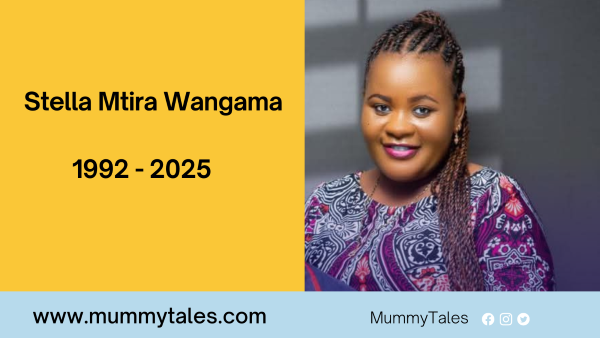
On 16 December 2023, Stella Machocho Mtira Wangama exchanged wedding vows with the love of her life -Hon. Duncan Wangama in a colourful, memorable ceremony. The couple hoped to build a beautiful life and family together –right into their sunset years.

Sadly, that was not to be, for on 8 July 2025, Stella passed away just a day after delivering their first child –a beautiful daughter named Judy. 33-year-old Stella succumbed to post-birth complications following a caesarean section (CS) delivery.

In his tribute, Stella’s husband wrote:

“Today, words fail me. My heart is broken, heavy and lost in a place I never imagined I would find myself so soon. Just a few hours after you brought our beautiful daughter, Judy, into this world, your side of life’s journey came to an end. A new life began as yours was called home. The pain of that exchange is a weight I can barely carry….

….My Stella, my precious, my sister, my best and favorite friend, though your body lies lifeless, your spirit lives on in me and in our daughter, Judy.

I promise to carry on the work you started with courage and compassion, without fear or discrimination. I will raise Judy with love, with values, and with purpose, just as we dreamed. She will grow up knowing who her mother was—strong, beautiful, loving, kind, resilient, and full of grace. I will raise her in ways that honor your legacy.”

Sadly, their precious daughter Judy also passed away a few days later. What a devastating loss to Hon. Duncan Wangama, the MCA for Wusi Kishamba Ward in Mwatate, Taita Taveta County.

Stella’s husband, Duncan Wangama, is comforted during her burial. Photo credit: The official Facebook page of Hon. Duncan Wangama -Igho Itini-MCA Wusi Kishamba..

The unfortunate death of Stella Machocho Mtira is the sixth of the Wanjiku Kumbukumbu project by Mummy Tales, an initiative that is focused on documenting maternal deaths in Kenya to raise awareness about the issue and advocate for better maternal health. The project aims to memorialize Kenyan mothers we have lost to childbirth complications. 

Read previous ‘Wanjiku Kumbukumbu’ stories below:

If you would like to share information about a mother who has lost her life due to maternal health complications in 2025, or if you would like to support the Wanjiku Kumbukumbu project by Mummy Tales, please reach me at maryanne@mummytales.com

Mummy Tales by Maryanne W. Waweru is a platform dedicated to empowering its readers on different aspects of womanhood and motherhood. Read more motherhood experiences of Kenyan moms here. Connect with Mummy Tales on: FACEBOOK l YOU TUBE l TWITTER

Advertisement

POPULAR POSTS

error: Not Allowed