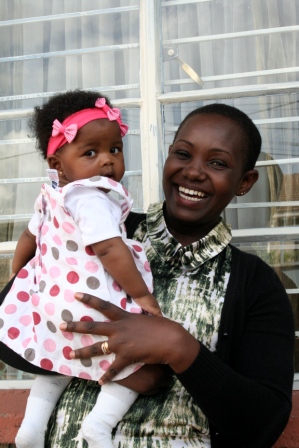
In the course of my work as a health journalist, I have come across cases of babies who have died of tuberculosis, sadly. In most of the cases, their parents wonder where the child got the TB from. Was the child born with it? Could they have gotten it from their mother? Or did they get it from those around them –the dad, sister, brother, housegirl? Or could it be visitors who came to see them then they looked at them with a ‘bad eye’? Could they have been bewitched? Why did they die yet they were on treatment and seemed to have been getting better? Or was it the wrong treatment they were receiving in the first place?
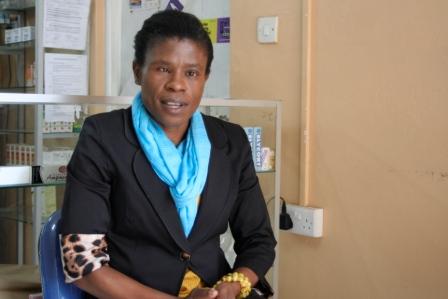
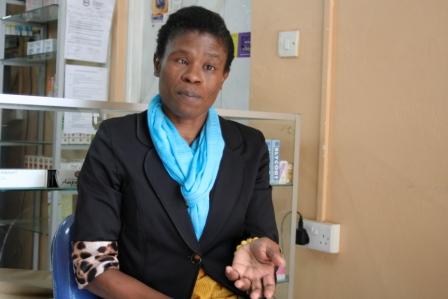
Well, Dr Lorraine Mugambi Nyaboga, the TB Technical Advisor at the Centre for Health Solutions – Kenya gives us an expert’s answer to this.
“TB in children, and especially children under the age of 1 year is quite difficult. Children will always contract TB from someone who has it and in most cases, someone they have prolonged contact with. This means that they will usually contract TB from a household contact or caregiver, and almost never from a casual visitor. Adolescents may contract TB from school. Also, a child can be born with TB if their mum had it while pregnant.
Generally, children with TB will present with cough, fever, failure to add weight and reduced playfulness. Many times, the mother will give a history of the child as having been treated for pneumonia severally.
Once TB is suspected, the doctors will usually ask for sputum tests, chest x rays and other tests depending on where the TB is located. It is possible to have TB of the lungs (which is the most common), the spine, brain and other places in the body, so tests may depend on whether the TB is located.
Once TB has been confirmed, all household contacts of that child must be screened for TB in order for them to be treated. Treatment of TB in children just as in adults is 6 months long and adherence to medications is imperative for them to be cured. Most importantly, TB can be prevented, and if treated on time, it can be cured.
Death usually occurs if diagnosed late or treatment is not consistent.”
Hope that information from Dr. Mugambi has given you some valuable information. One thing I know for sure is that TB drugs must be taken as prescribed without fail. No defaulting. Adherence is key.
Share this information with those around you.
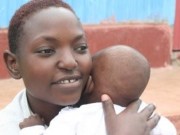
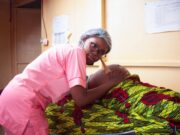
*Top image: New mothers receiving health information at a clinic in Kawangware.
Nabubwaya Chambers is a Kenyan mom raising her 11 month old son together with her husband Lee in Texas, USA. Last time, Nabubwaya told us about the maiden bus ride that she and her husband took their son on (read the post here). Today, she lets us know exactly how that trip to the mall went.
“We took a nice, relaxing walk around different stores at the mall as we did some window shopping. Lema was still asleep. As we walked around, I thought to myself of how good it always is to find great deals around town. For some reason, it always seems as though there is a ‘sale’ every month, where there are good deals in most stores.
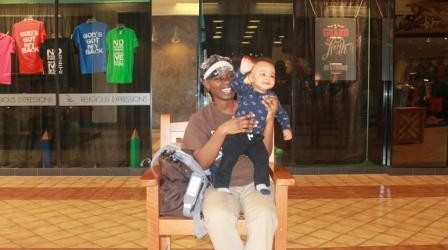
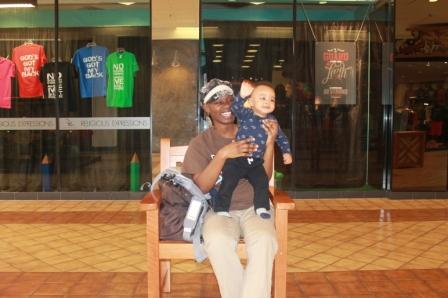
When we decided to take a seat at one of the benches, Lema immediately woke up. It’s interesting how he seems to doze off when we are in motion but once the movement stops, he wakes up instantly. It’s the same thing he does when he’s being rocked while fussing or sleepy.
I then fed him some milk then we took a few photos as we watched the train pass by our bench. We had picked a spot next to some really cool mobile toys that caught his eyes. He kept starring at them and clearly seemed to gravitate towards those toys.
Baba Lema and I decided to get some tickets to take him for a train ride. So we cued and paid for our ticket and as you may have guessed, there was a deal included…buy two get one free ticket. The Kenyan in me enjoys hearing the word “free”. Everything else doesn’t matter before and after the word “free” when it comes to sales and deals at stores.
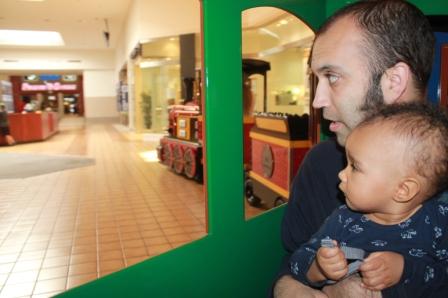
The train ride was the coolest part of that tour of the mall. Lema was so fascinated and just kept gawking at everyone on board including the passersby. He would occasionally glance towards our direction then back to the fascination of the moment. I enjoyed watching his reaction every time the train choo-chooed and made cool turns. After a few minutes, our ride came to an end. We took more photos, had a meal at a café, shopped for some books, toys, and movies then headed back to the bus stop to catch our last bus ride back home in great stride. At this time we had a very happy, well rested, entertained, and energetic baby in tow.
We boarded our bus and no sooner had we sat down than the energetic bundle of joy fell asleep in his father’s arms. He was totally wiped out. Thanks city bus for helping our baby nap so effortlessly.
We had fun times and I guess Lema’s first bus rides will certainly be well thought of and fondly remembered for years to come.”
What plans do you have for today? If you’re still looking for a ‘plot’ then you can consider attending the Twakutuza worship concert happening today at Nairobi Chapel, Ngong rd.
Twakutuzuka is the brainchild of Doris Mayoli a mother of two boys who was diagnosed with stage three breast cancer in 2005. Nine years later, Doris is cancer free, having been lucky enough not to be one of 27,000 people who lose their lives to cancer each year.
With a second chance at life, Doris today helps cancer patients in the fight for their lives through music. She organizes the Twakutukuza worship concerts, whose proceeds go towards helping cancer patients meet medical bills and have a second chance at life, just like she did. This she does courtesy of Twakutukuza Trust.
In her weekly news feature segment ‘Women and Power’ on NTV, host Victoria Rubadiri had a chat with Doris on her cancer journey.
Have a look at it here and if you’ll make it to the concert, see you then. Carry your kids along.
https://youtu.be/uAC4mmKAi8U Have a blessed weekend.
“Ever since I was a little girl, I always desired to have my own child, but nature did not seem to favour me in that way. I have now accepted the fact I will never give birth to my own child,” says 40 year-old Jacklyne Nekesa Nyongesa.
In 2009, Jacklyne had her uterus removed, in a surgical procedure known as a hysterectomy. She was aged 35 years then and even though she did not wish to have her uterus removed, it was her only option if she needed to stay alive.
Jacklyne’s journey to the loss of her uterus began in 1997 where for a period of time, she experienced heavy bleeding accompanied by intense pain to the extent that she would pass out. With time, the bleeding became constant and would see her bleed every single day of the year. Her bleeding would not be light, no. It was heavy bleeding, the one that is accompanied with huge clots.
“Pads would not help as the blood would sip right through them and onto my clothes. I always had to carry a change of two or three clothes in my handbag. I was studying at that time and it became difficult for me to move around as I had to constantly keep dashing into public toilets to change my soiled clothing. I always soiled my clothes, no matter how thick the pad was, no matter how often I changed the pad. It was so bad, so embarassing, so depressing that eventually, I decided to stop going to college and preferred to stay indoors,” she remembers.
As the bleeding continued, it would be accompanied by feelings of nausea, vomiting and extreme fatigue. Jacklyne then decided to visit Kenyatta National Hospital where there doctors ran a series of tests on her, including a pregnancy test.
“The tests showed that my pregnancy hormones (hCG) were very high. This puzzled me because I knew for a fact I was not pregnant as I was not sexually active. At all. So I found the test results very odd. An ultrasound later showed that I had abnormal growths in my uterus. It is these growths that were mimicking a pregnancy, hence the symptoms of a first-trimester pregnancy,” she says.
The doctors then took tissue samples from Jacklyne’s uterus, which established the presence of cancerous cells along her uterine wall. Jacklyne was diagnosed with an unusual type of cancer called choriocarcinoma, which is a cancer that occurs in a woman’s uterus (womb). Jacklyne had to undergo two surgeries in a span of six months to remove the abnormal growths, as well as undergo chemotherapy to destroy the tumor cells. She underwent a total of 15 cycles of chemotherapy.
However, the pain and bleeding never stopped, despite the two forms of treatment.
“As the years went by and the bleeding and pain got worse, the doctors recommended having my uterus removed, but I resisted this. I would hear none of it because I believed I would, with time, be healed of ‘my condition’, meet a nice man, get married and have babies,” she says.
So for the next 10 years, Jacklyne experienced heavy bleeding accompanied by intense pain every single day. Due to the loss of blood, she became anaemic and lost count of the number of times she had to undergo blood transfusions. The disease affected not only her physical and emotional health, but her social life too.
“I could not date. I could not be intimate with a man because I literally bled every single day of my life,” she remembers.
She began contemplating having the surgery to remove her uterus done after all, because of all the many problems she was having. Her cancer had even started spreading to other parts of the body.
“A hysterectomy was the only solution if I wanted to stay alive. My dream of birthing my own babies had to come to an end,” she sadly remembers. Finally, in 2009, Jacklyne gave in and heeded the doctor’s call to have her womb removed.
After the hysterectomy, the bleeding and pain stopped and for the first time in 12 years, she did not have to wear a pad or carry an extra set of clothes in her handbag. She could move around freely without having to think of where the closes public toilet was.
It has been 5 years since Jacklyne had her uterus removed. Even though still still single at 40, she hopes to find love someday.
“Most men want a woman who can bear them children. I am yet to meet a man who doesn’t want that. Maybe our paths will cross someday. For now, I am considering adopting a child,” she says.
Today, Jacklyne volunteers at the Texas Cancer Center in Nairobi where she interacts with cancer patients and survivors.
Early Thursday morning, I’ll be travelling to Turkana. It’s a county I’ve never been to be before, and I’m eager to visit the place. Anyway, why am I going to Turkana?
Well, this Friday 17 October happens to be the UN International Day for Eradication of Poverty. On this day, Children from the toughest places in the world are given a voice. It is a day for them to be heard –loud and clear. In Kenya, Turkana is one of the toughest places to be a child. Of all the 47 counties we have, Turkana is the poorest of them all. It is quite sad to learn that the death rate for infants in Turkana is 3 out of every 50. Also, only 54% of children in Turkana are fully immunized (those aged 0 – 5 years).
The most prevalent health problem for children in Turkana is malnutrition. Meaning that their bodies do not have the proper amount of nutrients that are needed to help them function well and remain in good health.
And it doesn’t end there, for being a mother in Turkana is equally difficult.
The maternal mortality ratio is 1,500 deaths for every 100,000 live births, which is three times the national average. Now, because of my writing about mothers and children here on my blog, as well as my work as a health journalist in the newspapers, I received an invitation from the NGO Save the Children to accompany them to Turkana during the UN International Day for Eradication of Poverty, where the focus is on the children in difficult areas.
This will be an opportunity for me to witness first-hand the situation of mothers and children in Turkana. And I’ll share that information with you here.
Meanwhile, here is a little video that talks about the need for children to have superheroe’s –with you being the first superhero. Be that role model to every child you engage with.
Nabubwaya Chambers is a Kenyan mom raising her family in the US. She shares some of her motherhood experiences with us. This week, she talks about Lema’s first bus trip, and the excitement that was. Lema is now 11 months old.
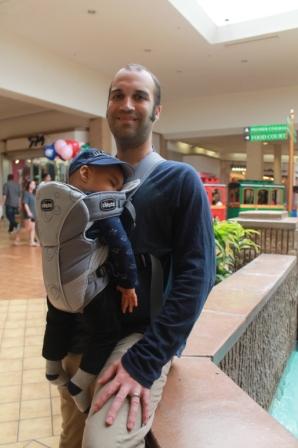
Lema’s first trip on a bus was nothing short of exhilarating. His dad and I took him for a walk on a warm, Saturday afternoon in his carrier. As soon as we left the house, he was kicking and raising his arms in the air to signal his approval and excitement of the impending trip.
Because Lema totally loves to be carried in his baby carrier, we must ensure that we are physically fit in order to be able to carry him this way. It doesn’t get easier because 1) we are getting older and 2) he is getting heavier by the day.
We have a bus stop that is about 10 minutes away from our home. Thank God it is not too far away because by the time we were leaving the sun was scorching and the heat getting stronger. Our Lema though was well prepared for the sun, evidenced by his clad in a baseball cap, sunscreen and had appropriate clothing on. Though this didn’t really matter to him anyway as all he cared for was his first trip in the bus.
After a few minutes of waiting for the scheduled bus, we finally got in. Lema was so excited that he started kicking his feet in the air again. We identified seats at the back and sat. As we settled, I noticed Lema immediately casting his eyes around and looking around as far as he could. With a smile on his face, he began engaging us in conversation. This is how it went:
Baba & Mama Lema: Hey buddy, so what do you think about your first bus ride to the mall?
Baba & Mama Lema: Yes! We bet it is so exciting! We remember our first bus rides too. They were so full of adventure. We never wanted to get off the bus. Is it the same for you?
Lema: Tho tho tho aaaaaa! Aaaaaa!
Meanwhile, he is pointing outside the window with a grin on his face.
Baba & Mama Lema: We can see lots of cars out there but no people walking. It seems Lema is getting tired all of a sudden. Is it nap time, baby?
Lema: Tho tho tho tho!
Lema then proceeded to happily take a nap while resting his head on Baba’s chest. I guess the entire walk to the bus and lots of excitement in the bus wore our baby out.
Thankfully, he got his nap and we were happy parents. We proceeded to take a few photos and carry on our conversation while he napped.
The bus arrived at its destination after a few minutes and we got off and walked into the mall. We figured it would be a good opportunity to get some walking exercise in and for Lema to get a well deserved nap too. The afternoon couldn’t go any better with a well rested baby.*Read more of Nabubwaya’s motherhood experiences here.
I recently traveled to Kisii county to cover a free fistula medical camp. The camp was at the Kisii Level 5 Hospital, and the women were receiving free surgery courtesy of the Freedom From Fistula Foundation and the Flying Doctor’s Society of Africa.
As I interviewed the patients, one of the most outstanding cases was that of a little four year-old girl. She wasn’t even a woman. Just a girl.
The little girl had presented with a traumatic gynaecological fistula. She had both vesico-vaginal fistula (VVF) and recto-vaginal fistula (RVF), meaning that she leaked both urine and faeces. She received these injuries following a sexual assault incident in her Kisii hometown after being defiled by a 16-year-old boy — a neighbour well known to her.
During the brutal attack, both her vagina and rectum were ripped apart causing extensive damage to her genital perineum areas.
Her mother, 20-year-old Mary Kwamboka (not her real name) narrates the events surrounding her daughter’s defilement.
“On that day, I left the house at about 4pm and headed to the local market to sell vegetables. I left my daughter playing in the compound with three other children, the eldest being seven years old. My mother, who was undertaking chores in the house, would keep guard over them as was the norm,” she remembers.
A short while later, Kwamboka’s mother would step out to the farm to pick vegetables to include in the family’s evening meal. She was out for only 20 minutes but when she returned, she noticed one of the children was missing. She alerted her neighbours and the search for the four-year-old girl began.
When Kwamboka returned from the market two hours later, she was devastated to hear the news of her missing daughter. She joined in the search, which unfortunately had to be put on hold when pitch darkness set in.
“The following morning at 6am, my cousin, on her way to school, alerted me of a faint cry emanating from a tea plantation near our home. We hurriedly followed the cry and when we got there, what I saw made me weak in the knees. I saw the naked body of a little girl with blood oozing from her face, neck and private parts. She was crying, her face swollen and hardly recognisable. But I knew it was my daughter,” Kwamboka says, struggling to hold back the tears.
Kwamboka, with the assistance of the local chief who happened to be passing by at that very moment, took her daughter to the police station and later to the local district hospital. But due to the extensive injuries suffered, the girl could not be attended to and was instead referred to a higher hospital — the Kisii Level 5 Teaching and Referral Hospital — for further management.
When the girl was able to speak, she recounted details of what happened that evening.
“As the four children were playing, and just after my mother had stepped out to the farm to pick vegetables, our 16-year-old neighbour approached my daughter with a slice of bread. After eating it, he asked her if she wanted another slice and when she said yes, he asked her to accompany him to his house for more bread. Since he is well known to our family, my daughter went with him to his home. There, my daughter says he did not offer her more bread but instead raped her all night long. In the early morning, he carried her to a nearby tea plantation where he dumped her,” narrates a pained Kwamboka.
The rape incident not only left the little girl nursing physical injuries on her face and neck which Kwamboka believes were as a result of slapping, punching and attempted strangulation, but extensive damage to her private parts as well. The previously healthy girl was now unable to control her urine and faeces.
But her treatment would not be straightforward. Because of the extensive damage to her bowels, a fistula repair surgery could not be immediately performed.
According to Dr Stephen Mutiso, one of the fistula repair surgeons attending to her at the hospital, the girl had to first undergo a colostomy due to the severity of the injuries.
“The colostomy will allow part of her intestine to rest and heal first before we attempt any further surgery. We created a new path for her stool to leave the body by making a hole in the abdominal wall which now drains her waste into a pouch,” he said during the camp.
Following the colostomy, the girl will then need to undergo a second surgery — that of repairing the vesico-vaginal fistula and recto-vaginal fistulas.
Once healed, a third surgery to reverse the earlier done colostomy will be done on her. This will be about a month after the fistula repair surgery when the surgical area has sufficiently healed.
In the meantime, Kwamboka cannot help but agonize over the future of her child. Her daughter’s defilement has brought uncontrollable tears and sleepless nights for the form-three school dropout.
“I hope my child will fully recover from all her physical injuries. I also pray that she did not acquire HIV. I pray that she will not be psychologically damaged by this inhumane incident,” she cries.
As her four-year-old daughter lay in a hospital bed next to a 72-year-old fistula patient, her mother cried for the innocence of her little girl.
“She is just a girl, not even a woman. What does she know about life? I cannot understand why someone would do this to a child!”
For now, her only hope lies in the Sexual Offences Act. According to the law, the defilement of a child aged 11 years or less attracts a mandatory sentence of life imprisonment.
“My greatest wish is to see to it that justice has been served to the man who did this to my daughter. If it were up to me, I would wish he were killed immediately but unfortunately, I have to abide by whatever the law dictates,” she says.
*At the time of my interview with her, the alleged perpetrator of the girl had been arrested after the minor positively identified him.
Have you been following the case of the Kenyan mom who sued Rusinga School for kicking her son out of class because of his dreadlocks?
Well, the ruling was made this week and here is how it went, as reported in The Star.
“A six-year-old boy who sued Rusinga School after he was ordered to cut off dreadlocks has lost his legal battle to keep his long hair.
In a judgment yesterday, High Court judge Mumbi Ngugi dismissed the case on grounds that he failed to convince court that his culture and religious rights had been violated.
Ngugi said it was clear the boy’s mother wanted him to keep dreadlocks for fashion and not religious reasons as she had alleged. She said the mother knew all along, since she enrolled him at the school’s kindergarten in 2010, that dreadlocks are not permitted.
Ngugi said the mother signed the school’s code of conduct agreeing to observe rules and regulations. The judge’s decision means the boy who has missed school since September 7, will have to either cut off his hair to enable him resume school or look for another school that will accommodate his style. The boy’s mother went to court protesting that the schools directive to have her son’s hair chopped off was discriminative.
She told justice Ngugi that her son completed the four-year kindergarten school without complications, but when he reported on September 7 to enroll in the preparatory school he was told he could not be accepted until he cut his hair.
She argued that the boy’s father is Jamaican and the dreadlocks are part of his culture. The mother wanted the school to be compelled to accept the boy back, saying the decision is illegal as it discriminates on gender, religious and cultural grounds.
The school, however, said it is a Christian school and does not accept boys to have dreadlocks. In her ruling, Ngugi said courts have no desire in interfering with the running of institutions, adding that schools must be allowed to govern their pupils.
“The petitioner has not shown this court that the child practices Rastafarian religion, had she proved this, she could have persuaded this court,” she said.”
So that’s how it ended.
What do you think about the whole issue? Do you think the boy had a valid case? Or do you think the judge was fair in her decision? What do you think of the mother’s decision to pursue this case legally? Would you have done the same thing?
Since its cancer awareness month, I am currently working on a cancer article and yesterday, I went to interview a doctor for an expert input.
Now, this doctor was very good in the sense that he did not rush the interview. In my own experience, some doctors always seem to be in a rush to go to I don’t know where. When I have seen them either as patient or a journalist, the clock ticks very loudly in the consultation room and I find myself speaking very quickly, panting and literally running out of breath. Not that they are usually chasing me or anything, but there’s something about that interaction that makes you feel as though you just need to hurry up already.
*sigh*.
Do you have the same experience too?
Anyways, the doctor I interviewed yesterday was different. A very soft-spoken doctor who did not seem to be in a rush to go to I don’t know where. He gave me all the time in the world and I found myself not panting and running out of breath.
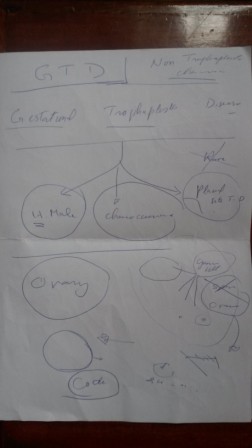
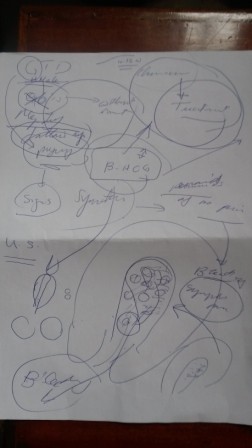
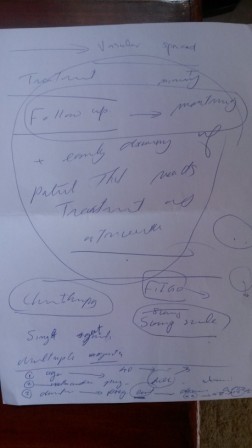
As we commenced the interview, and as he began getting into the technical issues of the cancer I am writing about, he told me to relax and not take notes, that he will share the notes he was writing afterwards.
He was explaining his points on a piece of A4 paper and was helping me understand the technical issues in a manner that a layman can understand (I am very much a layman when it comes to medical jargon). The interview lasted about 30 minutes.
And after the interview, he handed me the notes for me to go home and refer to as I worked on my article.
This is how the good doctor’s notes looked like.
Woooii!!
I did take my own notes though. But all in all, I have mad respect for doctors. How can you not? The nature of their work simply requires a brilliant mind, selflessness and commitment. As a health journalist, I am in continuous awe of their work.
Last week, I met a young mom called Selina Odongo Ojwang’. Selina is mother to a seven-month old daughter called Nina Natania. Nina means ‘God’s grace’ while Natania means ‘God’s gift’. Quite interesting names which have a deep meaning to Nina’s parents.
As I chatted Selina and watched her play with and cuddle her daughter, she mentioned to me that it is still yet to dawn on her that she is actually a mother. This is because the road to motherhood for this 30-year-old insurance sales agent has not been an easy one.
It all began two years ago when she fell pregnant with her first child. Excited at the thought of becoming a mother, Selina focused on a healthy lifestyle which included eating right and engaging in mild exercise. She also dutifully attended her antenatal clinics.
But one day, at 16 weeks pregnant, Selina felt a sudden gush of warm liquid surge through her legs. She immediately rushed to hospital where she was informed that her waters were breaking prematurely. Unfortunately, she lost the baby.
“It was a handsome little boy,” she remembers.
Still hopeful about becoming a mother, Selina conceived again three months later. This time round though, she found herself extremely paranoid about the pregnancy.
“I worried alot and feared I would lose the baby. I became very cautious in everything I did, careful not to put myself in harm’s way,” she remembers.
To ensure all would go well, Selina opted to see one of the best consultant gynaecologists in town for her antenatal visits.
After learning about her previous miscarriage, which he suspected was likely caused by a weak cervix, the doctor suggested the option of a cervical cerclage, which involves closing the cervix with a stitch. With the cervical stitch in place, it would reduce the likelihood of her cervix opening up prematurely due to pressure from the growing foetus.
However, after taking her through a series of tests during her 16th week of pregnancy, the doctor informed her that she did not need to have the cervical stitch after all.
“The tests established that my cervix was competent enough to carry the pregnancy to full term,” she remembers.
Relieved at the news of a complication-free pregnancy, Selina relaxed and began shopping for her baby.
However, this joy was not to last for long as three weeks later, on Christmas day 2012, she felt the all familiar gush of a warm liquid spurt through her legs.
“I could not believe it. There was no way I could be losing my baby again. How, yet the doctor assured me all was well?” she cried as she dashed to the hospital. Unfortunately, her gynaecologist was out of town as it was the festive season so she settled for the nearest hospital.
At the hospital, an ultrasound on her 19-week pregnancy was done, which revealed that the baby had a regular heartbeat, though the amniotic fluid was less than usual. But it was the doctor’s words that shocked her most.
“Just get rid of that thing,” he announced, referring to her foetus.
Selina was taken aback by his attitude.
“The doctor showed no sympathy or concern for me. His words pierced me deeply,” she remembers.
Despite the doctor’s suggestion, Selina and her husband would hear none of it.
“We were not going to kill our baby. The ultrasound showed the baby’s heartbeat was existent. I could feel the baby playing and kicking inside me, so how could I terminate the pregnancy?” she wondered.
For the next few days, Selina remained in hospital hoping for a medical miracle. But each time the doctor came to review her, he would scold her, asking her why she was taking long to ‘get that thing removed’.
“Those were the most heartless words I have ever heard. I will never forget that doctor for as long as I live,” she says.
Sadly, as the hours passed, the baby’s heartbeat and the kicks gradually became faint. By the third day, the medics could not trace a foetal heartbeat and the movements in her belly were no more. Labour had to be induced for her to deliver the now-dead foetus.
“The hospital nurses wrapped the baby in a shawl and handed the baby over to me. It was another baby boy. I took a few photographs of him before they took him away,” she remembers.
Losing a second pregnancy hit Selina hard. She spent the next two months holed up in her house, mourning her two unborn sons.
Her sorrow was made worse by people’s talk.
“When I went to church, I was turned away from the choir which I had faithfully served in for many years. I later discovered word was that I was a great sinner and God was punishing me for several abortions apparently procured before I got married. Some church members said I was bewitched and therefore did not belong in their fellowship. To date, I have never returned to that church,” she says.
But the church was not the only place she would face rejection.
“Friends stopped inviting me to baby showers as they believed I carried an evil spirit that killed unborn babies. Whenever I visited new mothers, I noticed they would not allow me to hold their newborns as they believed my hands carried death.”
Distressed by the happenings in her life, Selina decided to bury herself in her work. She also put on hold trying for another baby as she did not feel ready to cope with another disappointment.
However, nine months after her second miscarriage, Selina began feeling nauseous. Familiar with the symptoms, she took a pregnancy test. The results were positive.
“I was disappointed. I was on the birth control pill and was unprepared for another pregnancy. I was not emotionally and physically ready to deal with the rigours of losing another baby,” she remembers.
Certain of another miscarriage, Selina decided not to seek any antenatal care but instead wait for nature to take its course.
“I was already familiar with the routine. My waters would break in my fourth month, I would rush to hospital, I would be induced and then give birth to a dead foetus.”
But her husband, a medical doctor, urged her to have a positive outlook about the pregnancy. She resisted, but eventually conceded in the third month where she agreed to start her antenatal visits.
This time round though, Selina insisted on a cervical stitch. The first gynaecologist she went to declined to give her the stitch, instead giving her alternative medication.
“While I took the drugs, I decided to search for another doctor who would give me the stitch. I was not going to rest until I had the stitch. If I lost the baby, it was going to be because of something else but not because of a weakened cervix,” she remembers insisting.
Finally, after a wide search, she found a doctor who understood her concerns. When she saw him at 14 weeks pregnant, he ran some tests on her. The results showed that her cervix was already opening up.
“In a few days time, I was going to suffer another miscarriage. He booked me for the surgical procedure the following week. But I never made it to the appointed day as three days to the date, I began having pains in my belly and after rushing to hospital, I was told my cervix was dilating. The doctor gave me an emergency cervical stitch — the McDonald Stitch.”
The rest of the pregnancy was delicate, where Selina remained indoors for most of the time following strict instructions from her doctor.
“They were very agonising months as every passing hour, I kept dreading that my waters would break anytime. There entire pregnancy was spent in great fear of me losing my baby,” she remembers.
But the pregnancy progressed well without any major incident.
However, Selina faced another pregnancy scare at 36 weeks when she began developing preeclampsia, another pregnancy complication that could be fatal. Her blood pressure was alarmingly high, she was nose bleeding and her face, feet and hands were extremely swollen.
This condition necessitated the doctor to remove the McDonald stitch and the following week, Selina gave birth to a healthy baby girl through normal delivery.
Today, her daughter is a healthy, bubbly seven-month-old who has never suffered any ill-health.
Does Selina plan to have more children?
“Yes, but I will always insist on a cervical stitch. That is a must, something I will never compromise on,” she vows.
Selina also urges other women who have suffered miscarriages to read widely about cervical stitches, and have a discussion with their doctor about it as a possible solution to their miscarriages.
“No woman should have a miscarriage that can be avoided,” she said, as we concluded the interview.
And that is why the couple named their daughter Nina Natania. Indeed, she is God’s gracious gift.
Also see helpful information in the video below:
What is a Cervical Stitch?
– A cervical cerclage (stitch) is given in the case of a weak cervix (cervical incompetence). The stitch is placed in the cervix as a precautionary measure to keep it closed and prevent it from opening up prematurely during pregnancy.
– The stitch is usually inserted between 10-16 weeks, though in some cases it can be inserted a few weeks after that.
– The stitch is usually removed at around 37-38 weeks of pregnancy.
Mummy Talesis an organization dedicated to empowering its readers on different aspects of womanhood and motherhood. Follow Mummy Tales on:FACEBOOK l YOU TUBE l INSTAGRAM l TWITTER
*I first published this article in The Star newspaper.







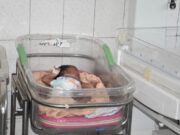




















 It is quite sad to learn that the death rate for infants in Turkana is 3 out of every 50. Also, only 54% of children in Turkana are fully immunized (those aged 0 – 5 years).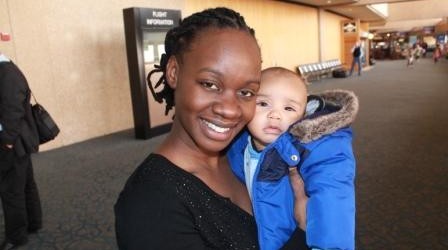





 But all in all, I have mad respect for doctors. How can you not? The nature of their work simply requires a brilliant mind, selflessness and commitment. As a health journalist, I am in continuous awe of their work.